Introduction to Advanced Slipper Customization
In the highly competitive global footwear market, brands must constantly innovate to capture consumer attention and build brand loyalty. Slippers made from Polyvinyl Chloride (PVC) and Ethylene-Vinyl Acetate (EVA) have evolved from simple utility footwear into stylish, highly customized lifestyle products. Today, major global brands leverage state-of-the-art customization techniques to transform these materials into premium merchandise that commands impressive retail margins. This guide explores the advanced techniques, material comparisons, and strategic workflows essential for successful slipper customization.
Whether designing for beachside leisure, athletic recovery, or high-fashion streetwear, understanding the technical differences between PVC and EVA is crucial. PVC is renowned for its durability, excellent flexibility, and ability to hold fine details, making it ideal for fashion-forward, intricate designs. On the other hand, EVA is ultra-lightweight, shock-absorbing, and highly resilient, making it the material of choice for sports recovery slides and premium comfort footwear. Aligning these material characteristics with correct manufacturing methods is the foundation of high-caliber product development.
1. Upper Section Customization Crafts
The upper of a slipper is the primary billboard for your brand. It is the first detail consumers notice and the area where visual identity must be strongest. Advanced manufacturing supports multiple high-end upper personalization methods to suit various brand aesthetics.
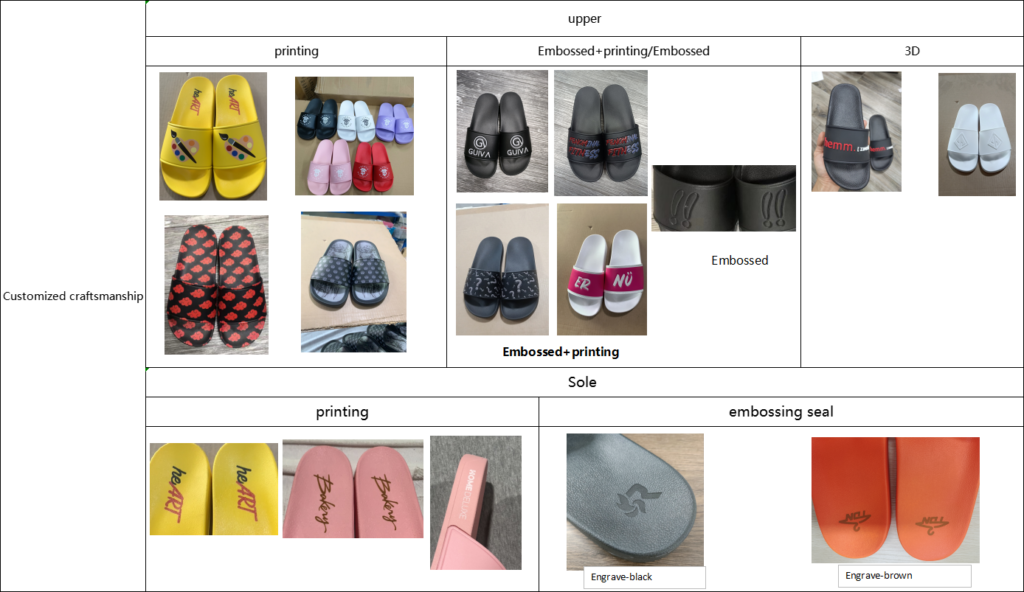
Printing (HE ART)
The Printing technique, showcased beautifully by the “HE ART” design, offers clean, vibrant, high-definition graphical replication directly onto the upper material. This method utilizes specialized, wear-resistant inks that bind seamlessly with the PVC or EVA substrate. It is highly suitable for multi-colored designs, artistic patterns, and branding that requires complex color gradients. Brands can achieve photo-realistic prints with outstanding longevity that withstand sun, water, and daily wear.
Embossed + Printing (GUIVA/ER NU)
The Embossed + Printing method, exemplified by the “GUIVA/ER NU” styles, is a hybrid craft that combines physical three-dimensional texture with colorful surface printing. This technique first utilizes custom-engraved steel molds under heat and pressure to emboss a raised pattern on the upper, creating distinct high and low points. Next, high-precision screen or digital printing is applied. The resulting 3D tactile feel and aligned color elements create an extremely premium, tactile depth that instantly elevates perceived brand value.
3D Logo
The 3D Logo craft represents the peak of modern dimensional branding. This technique involves injecting separate, multi-layered PVC molds or utilizing specialized high-frequency welding to create bold, protruding graphic elements that rise dramatically from the upper surface. This provides a striking physical presence, unmatched durability, and a highly modern, sporty aesthetic. The 3D Logo method is exceptionally popular among athletic brands, lifestyle labels, and premium merchandise creators.
2. Sole Section Customization Crafts
While uppers secure visual attention, the sole is where physical comfort and brand identity merge. Sole customization requires precise engineering to maintain slip resistance, structural integrity, and ergonomic support, while simultaneously incorporating branding.
Printing (Bakery)
Applying high-definition graphic prints on the sole bed, as seen in the “Bakery” design, allows brands to implement continuous lifestyle imagery, complex typography, and all-over artistic patterns. Utilizing scratch-resistant transfer films or UV-cured inks ensures the artwork remains vibrant even under constant foot friction. This technique is fantastic for creating immersive, themed collections where every square inch of the slipper tells a consistent brand story.
Engrave (Engrave-black/brown)
The Engrave technique, demonstrated by the elegant “Engrave-black/brown” styles, relies on physical indentation molded directly into the footbed or outsole. This craft produces crisp, indented branding lines that are extremely clean and permanent. Because no ink is used, there is absolutely zero risk of color fading or peeling. This craft provides a classic, understated luxury look that is highly valued by premium resorts, spa lines, and minimalist fashion houses seeking permanent brand recognition.
3. Customization Craft Decision Matrix
To streamline your design and sourcing workflow, use the professional decision matrix below. It contrasts all five major slipper customization techniques by visual impact, tactile feel, production lead times, setup costs, and minimum order quantities.
| Craft Technique | Visual Impact | Tactile Experience | Est. Lead Time | Setup Cost | Target Segment |
|---|---|---|---|---|---|
| Printing (HE ART) | High (Complex Graphics) | Smooth, flat surface | 15-20 Days | Low to Medium | Artistic & Lifestyle Brands |
| Embossed + Printing (GUIVA) | Very High (Combined) | Dual 3D texture & print | 20-25 Days | Medium (Custom Molds) | Premium Retail Labels |
| 3D Logo | Maximum (Bold/Sporty) | Heavy raised relief | 22-28 Days | High (Detailed Steel Molds) | Athletic, Streetwear & Merch |
| Sole Printing (Bakery) | High (All-over Coverage) | Smooth footbed feel | 18-22 Days | Medium | Fashion & Collaborative Drops |
| Sole Engraving (Black/Brown) | Understated / Elegant | Indented permanent grooves | 15-20 Days | Medium (Sole Mold Insert) | Minimalist & Resort Brands |
4. B2B Custom Slipper Sourcing FAQ
Q1: What are the minimum order quantities (MOQ) for custom PVC vs. EVA slippers?
A1: Typically, custom PVC slippers require an MOQ of 1,000 to 2,000 pairs per design due to material mixing and mold set-ups. High-quality compression-molded EVA slides generally start at 1,500 to 3,000 pairs depending on the size run and sole customization complexity.
Q2: How do custom molds impact the total cost and development timeline?
A2: Custom mold creation is a one-time capital expense (ranging from $800 to $2,500 per size mold). Developing and testing 3D CAD blueprints takes roughly 7 to 10 days, followed by sample prototyping which adds another 5 to 7 days. Once approved, mass production molds are finalized.
Q3: Can these customization crafts withstand harsh outdoor and beach conditions?
A3: Yes. All our uppers and footbed customizations utilize marine-grade, UV-stabilized inks and high-grade PVC/EVA resins. This prevents yellowing, color peeling, and micro-cracking caused by prolonged exposure to sunlight, salt water, and chlorinated pool water.
Q4: Is it possible to mix sizes and colors within a single production run?
A4: Yes, we welcome mixed size runs! Generally, we offer standard European or US size ranges (e.g., 36-45). Within a single MOQ run, brands can distribute quantities across multiple sizes. Changing the upper or sole base color is also possible, though it may require reaching smaller material batch minimums per colorway.
Q5: What file formats are required for custom artwork submissions?
A5: For the highest fidelity, we require vector files in .AI, .EPS, or editable .PDF format. If submitting 3D Logo or Embossed designs, solid-model 3D CAD files (.STP or .IGS) are highly recommended to ensure exact mold cutting.
Strategic Partnership and Next Steps
Choosing the right manufacturer is the final, most critical link in your supply chain. An experienced footwear factory does not merely execute orders; they act as a strategic co-developer. By evaluating material limits, advising on mold layouts, and proposing smart craft combinations, the right manufacturing partner can help you reduce setup fees, eliminate quality defects, and significantly accelerate your time-to-market. Transform your footwear ideas into high-margin retail successes by leveraging our advanced technical custom capabilities today.