A container of slippers is one of the easiest purchases in the footwear trade to get wrong. The product photographs well and the quotation looks reasonable. Then the shipment lands and the buyer finds a sole thinner than the sample, a size run heavy on the sizes nobody reorders, and freight and duty that added a fifth to the unit price. These are specification failures, cheap to prevent and costly to fix.
Buying slippers in bulk, or building a custom slippers wholesale program, means locking five things before money moves: a channel that matches your order size, a specification that matches the end user, a quantity band that earns the quoted price, a landed cost figure rather than a unit price, and an inspection point before the container is sealed. Handle those five and an order behaves predictably; skip one and the savings from the other four disappear.
The sections below follow the order a real purchase runs, from choosing where to buy to the paperwork that precedes the deposit.
Where Can I Buy Bulk Wholesale Shoes and Slippers?
Bulk slippers come from five sources: a factory that owns its molds, a trading company aggregating several factories, a business-to-business marketplace, a regional distributor holding local stock, and a brand’s wholesale program. The choice is decided by order size, how much customization the design needs and how fast stock must land.
Between roughly 500 and 5,000 pairs, buying direct from a slippers manufacturer is the usual route for a custom slippers wholesale program and the strongest position on price and specification control, because the party quoting the price also sets the foam density and signs the inspection report. Below 500 pairs the setup work rarely pays and distributor stock is the saner entry. Above 20,000 pairs, container economics take over.
How the five sourcing channels compare
| Channel | Typical first order | Best suited to | Main risk |
| Factory direct, owns tooling | 500-1,000 pairs per style | Private label and custom programs | More sampling work up front |
| Trading company | 300-500 pairs | Small mixed orders | Spec drift between quote and shipment |
| B2B marketplace | 100-500 pairs | Price discovery, first samples | Inconsistent quality between sellers |
| Regional distributor | 50-200 pairs | Fast replenishment, local invoicing | Narrow range, distributor margin |
| Brand wholesale program | Case packs | Retailers wanting a proven line | No spec control, no exclusivity |
There is no universally best place to buy slippers, and a supplier that says otherwise is describing its catalog. Two questions settle it: what delivered cost per pair looks like at your volume, and who is responsible when goods miss the approved sample. A channel that answers both in writing is worth a higher price than one that answers neither.
Match the Order to the End User Before Comparing Quotes
In a custom slippers wholesale brief the end user sets the specification, and the specification sets the price. A guest slipper expected to survive two nights and a retail slipper expected to survive two winters are different products, and quoting them against each other produces a comparison that means nothing.
The most common sourcing error is not a bad factory but a mismatch between durability grade and use case. Hotels turn rooms hundreds of times a year and expect a guest slipper to be consumed, not laundered. Spas wash the same pair dozens of times, which makes seam construction and quick-dry uppers more important than plushness.
| End use | Service life | Specification to fix first |
| Hotel guest room | One to three nights | Upper weight, 3-4 mm sole, individual polybag |
| Spa and wellness | 20-40 wash cycles | Quick-dry upper, molded sole, chlorine resistance |
| Retail | 6-24 months | 8-12 mm outsole, tread pattern, full size range |
| Events and weddings | One evening | Size spread, color matching, bulk carton packing |
| Rental and vacation property | 6-12 months, repeat washes | Washable upper, neutral color |
Write the replacement assumption into the brief: a property issuing 12,000 pairs a year is not making a comfort decision when it chooses between a pair that survives one night and one that survives three. Facilities with washable stock often find that a purpose-built wholesale spa slippers program costs more per pair and less per year.
MOQ and Price Tiers: What the Quote Really Depends On
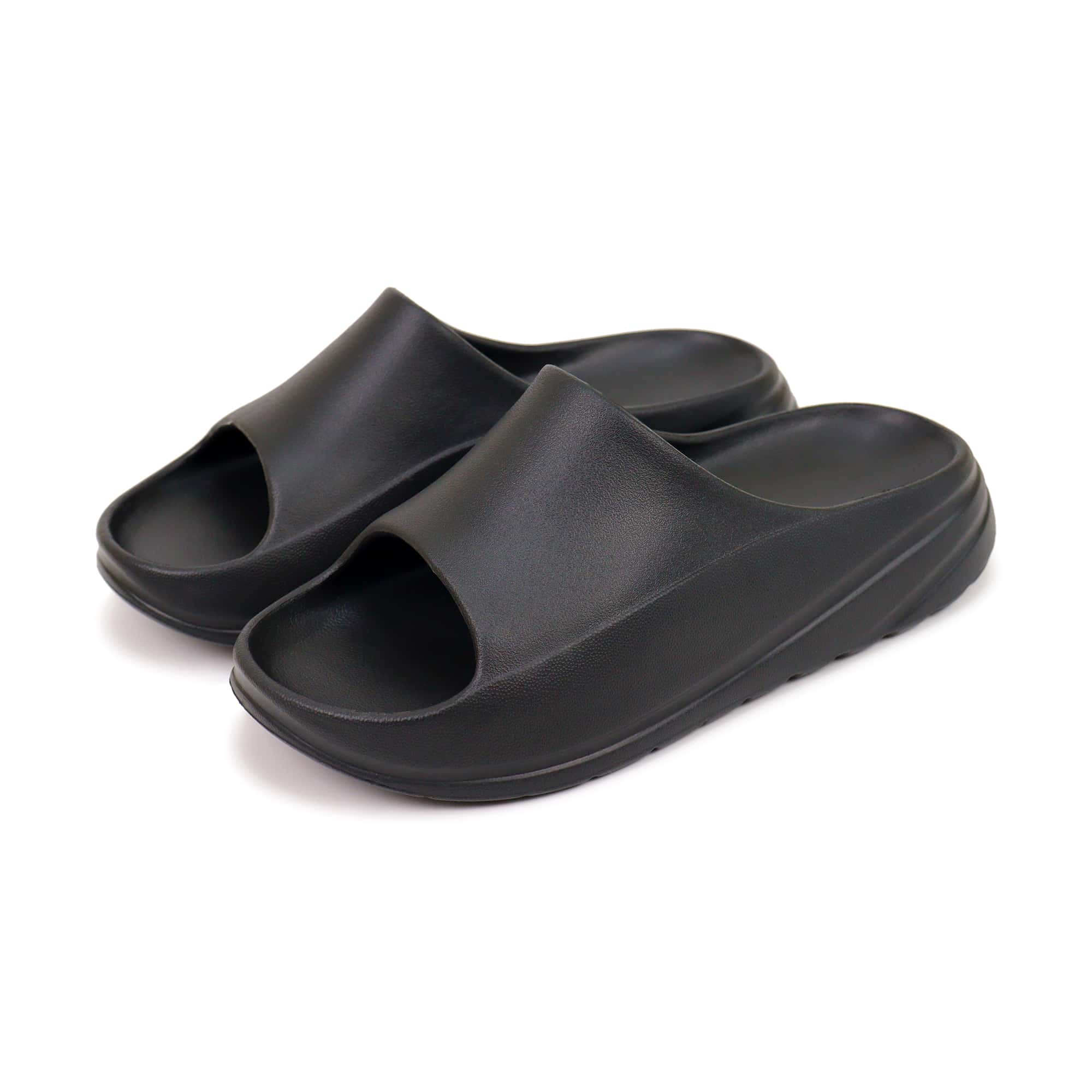
On a custom slippers wholesale order, minimum order quantity and unit price move together, but not in a straight line. Most factories price in three or four bands, the gap between the first and last is typically 25 to 40 percent, and the volume decision therefore matters more than the negotiation.
A 500-pair order and a 5,000-pair order of the same slipper are not the same product economically: the smaller carries setup, color changeover and sampling cost across a tenth of the units. A buyer who negotiates hard at 500 pairs and one who simply moves to 1,000 often land in a similar place, with the second holding less risk. The bands below are indicative 2026 factory-direct ranges.
| Volume band | Order size | Basic molded EVA, USD | Textile upper, USD |
| Entry | 500-999 | 1.45-1.80 | 3.30-3.90 |
| Core | 1,000-4,999 | 1.30-1.55 | 2.80-3.35 |
| Container | 5,000 and above | 1.15-1.40 | 2.35-2.90 |
Six items drive the quoted number: resin grade and density, upper fabric weight, sole thickness and hardness, decoration method, packaging format, and testing scope. Material accounts for roughly 55 to 62 percent of factory cost, labor 15 to 18 percent and packaging 8 to 10 percent, so a quote that undercuts the market by a third has moved one of the first three.
Minimum order quantity usually applies per color and per style, not per purchase order, so a buyer wanting four colorways may commit to four times the quantity discussed. Consolidating to two colors per style and letting the size ratio carry the variety is the cheapest way to keep a custom slippers wholesale order inside budget.
Where Can I Get the Cheapest Slippers and What That Price Hides
The cheapest slippers are almost always at the bottom of a price list and almost never the cheapest order. Landed cost, defect rate and reorder reliability decide what a pair costs a business, and none appears on a quotation.
Take a textile-upper slipper quoted at 2.45 USD per pair. The layers that follow the quotation are predictable.
| Cost layer | USD per pair | Note |
| FOB price | 2.45 | The number on the quotation |
| Ocean freight, full container | 0.10-0.14 | Route, season and loading density |
| Import duty | 0.10-0.20 | Follows construction and origin |
| Clearance, port fees, inland haulage | 0.03-0.06 | Higher for part-container loads |
| Defect and replacement allowance | 0.05 | Roughly 2 percent of order value |
| Payment, currency, inspection | 0.06 | Letter of credit and third-party audit |
| Landed cost | 2.80-2.95 | The number for the margin model |
Visible savings and hidden costs rarely sit on the same scale. Squeezing 0.30 USD per pair out of a 20,000-pair order releases 6,000 USD once, while one batch with a 3 percent defect rate can consume most of that in a single replacement shipment. Air freight to rescue a late season multiplies the freight line by eight to twelve.
Material and Sole Construction: Six Specs to Fix in Writing
Six parameters decide whether a bulk order matches its sample: foam density, sole thickness, sole hardness, upper weight and composition, single-pair weight, and color tolerance. All six belong in the purchase order as numbers, because words such as soft, thick and premium cannot be inspected at the gate.
Foam density is the parameter buyers most often omit and the one that best explains a disappointing reorder. Lighter foam saves material cost and recovers poorly after weeks of wear, invisible in a sample and obvious in a shop. Hardness matters as much: 35 versus 50 on the Shore C scale is the difference between gripping a wet tile and skating across it.
| Parameter | Typical range | Why it must be written down |
| Foam density | 0.12-0.18 g/cm3 | Sets compression set and useful life |
| Sole thickness | 3-12 mm by use | Drives value perception and wear |
| Hardness | Shore C 35-50 | Balances grip against support |
| Upper weight | 180-320 g/m2 | Determines warmth and wash durability |
| Single-pair weight | 120-300 g | Feeds freight calculation |
| Color tolerance | Within 1.5 units of swatch | Protects reorder matching |
A well-run factory accepts all six as contractual values, and one that answers with adjectives is telling you something useful. Buyers sourcing through a specialist EVA custom slippers line usually find these numbers already tabulated.
Slip resistance needs a test method, not an adjective
Every supplier claims a non-slip sole, and the claim is worth as much as the test behind it. The way to settle it is a measured coefficient of friction on a defined surface, which is what ASTM F2913 covers. The stakes are real: in a cohort of 765 older adults followed for falls, more than half of the home falls happened while barefoot or in socks or slippers, with roughly twice the odds of serious injury. For hospitality and care buyers, a friction figure on wet ceramic is a procurement requirement, not a marketing line.
Customization, Private Label and Who Owns the Tooling
Custom slippers wholesale cost is driven by three things: how the logo is applied, whether new tooling must be cut, and who owns that tooling afterwards. The first two appear on the quotation, and the third usually decides whether the second order is cheap or starts again from zero.
Decoration should follow wash cycles rather than budget. A screen print costing a fifth of an embroidered badge looks worse than either after fifteen laundry cycles, which is fine for a single-use guest slipper and unacceptable for retail. Molded-in logos sit at the other end: highest tooling cost, lowest marginal cost per pair, no wear.
| Method | Added cost per pair, USD | Practical minimum | Durability |
| Molded-in logo | 0.15-0.35 | 1,000-2,000 pairs | Life of the product |
| Embroidery | 0.25-0.60 | 300-500 pairs | 30 or more washes |
| Screen print | 0.08-0.20 | 300 pairs | Cracks after 10-15 washes |
| Heat transfer | 0.10-0.25 | 300-500 pairs | Fades with abrasion |
| Printed insole card | 0.03-0.08 | 500 pairs | Decorative only |
Tooling ownership separates a private label slippers program from a rental of someone else’s mold. A simple sole mold costs 400 to 1,200 USD, and the fair arrangement is that the buyer pays once, owns it and can move it if quality slips. Buyers who skip the clause discover on the second order that the mold belongs to the supplier and the quotation has reset.
Quality Control, Size Curves and Delivery Planning
A custom slippers wholesale order fails in three predictable places: a size curve that does not match the buyer’s market, an inspection that happens after the container is sealed, and a delivery date calculated from the wrong starting point. All three are planning failures, and all three are avoidable.
Build a size curve instead of an even split
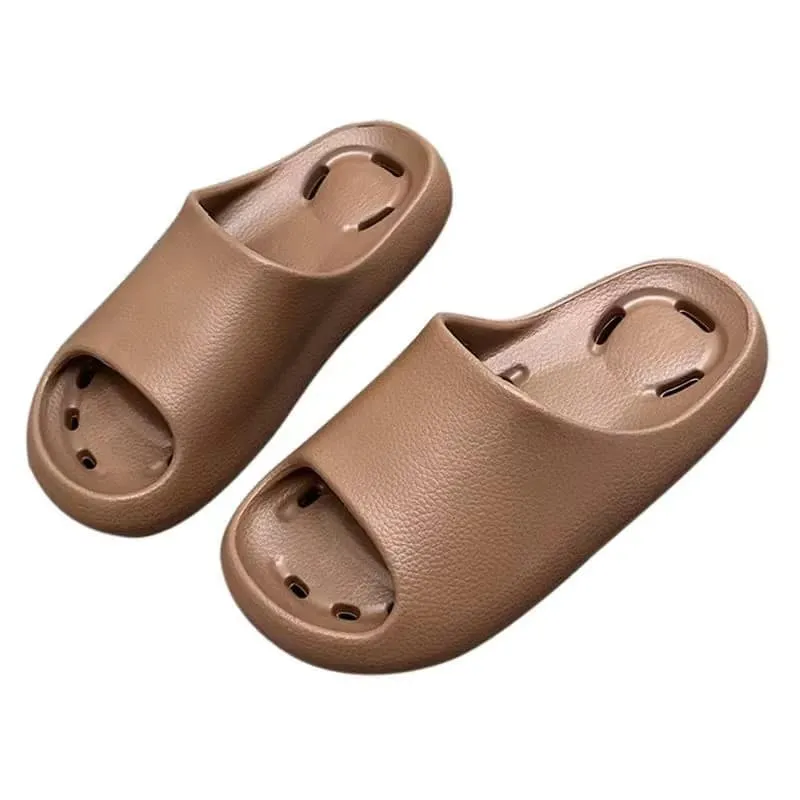
Even splits are the factory default when no curve is given, and they generate the same complaint: too many pairs at the extremes, too few in the middle. For a women’s range in European sizing, a workable starting point is 20 percent in 36-37, 35 percent in 38-39, 28 percent in 40-41, 12 percent in 42-43 and 5 percent in 44-45. Retail buyers should replace these with their own sales history. Hospitality buyers should widen the tails, because one unserviceable size becomes a room complaint.
Inspection points and documentation
Write inspection into the schedule twice: during production when the first cartons are packed, and before shipment when the order is complete. An agreed inspection level and quality limit give both sides a rule rather than an argument. The document set is short: restricted substance and color test reports, a friction report if slip resistance is claimed, and correct country of origin marking, which United States import rules require.
Timing follows from those steps, not from the supplier’s promise. Sampling takes 7 to 12 days, production 20 to 35 days when tooling is new, and ocean transit 18 to 38 days by route. A buyer who needs stock in week 12 should approve a sample in week one.
FAQ
Three questions come up in almost every bulk enquiry, and each is better answered before the order than after it.
Which brand is No. 1 for slippers?
There is no objective ranking, because the answer changes with the measure: by unit volume the leaders are contract manufacturers whose names never reach a shopper, by revenue they are retail brands. For a buyer placing a custom slippers wholesale order, the ranking is largely irrelevant. What matters is monthly capacity, export history, test documentation and whether the factory will hold a specification across reorders.
How many pairs fit in a 20-foot container?
The figure follows carton geometry. A compact slipper at 60 pairs per carton in a 50 x 40 x 30 cm box occupies 0.06 cubic meters, so 400 to 460 cartons fit the 25 cubic meters usable in a 20-foot container, or 24,000 to 27,000 pairs. A 40-foot high cube takes about two and a half times as many. Fluffy or boxed slippers pack far less densely, which is why packaging format belongs in the freight calculation.
Can one bulk order mix sizes, colors and styles?
It can, and most do, but three limits apply. Minimum order quantity is normally counted per color and per style, so mixing spreads the commitment rather than reducing it. Mixed cartons cost extra labor to sort and are a common source of pick errors. Every added color brings a new dye lot, which is where reorder matching problems begin. Two or three colors per style, with variety carried by size ratio, survives a real warehouse.