Slippers look like the simplest product in the footwear catalogue, which is why so many wholesale slippers programs fail quietly. A sample is approved, the carton lands, and the foam is lighter than the sample, the logo has cracked after one wash, and the packaging has cut container density by a third. None of that is a manufacturing accident. Each is a specification gap that was cheap to close at quotation.
Custom slippers wholesale is the supply of slippers built to a buyer’s own specification, covering sole tooling, foam density, upper material, logo application, packaging and size ratio, produced at volume by the party that controls production and priced in quantity bands with a minimum order per style and per colour.
The sections below follow the order a program actually runs, from deciding how much customization the product needs to inspecting the last carton.
What Custom Slippers Wholesale Actually Covers
Custom wholesale sits on a four-step ladder: a stock mold with a logo, private label on an existing mold, OEM development, and a dedicated mold cut for one buyer. Each step adds tooling, development time and minimum quantity, and each buys a different amount of differentiation.
A hotel replacing 12,000 pairs a year needs a durable logo and a reliable size spread, not a new last. A brand competing on silhouette needs the tooling, because a shared mold is a shared product.
The Four Levels of Customization
| Level | What changes | Typical first order | Tooling cost | Best suited to |
| Stock mold with logo | One decoration method on an existing style | 300 to 500 pairs | None | Hotel amenity, promotions, market tests |
| Private label | Buyer’s brand on product and packaging | 500 to 1,000 pairs | None to low | Retail, gifting, marketplace sellers |
| OEM development | Buyer’s design applied to the closest existing mold | 1,000 to 2,000 pairs | Low to moderate | Brands with a defined silhouette |
| Private mold | New tooling cut for one buyer | 1,000 to 3,000 pairs | 400 to 1,500 USD | Brands competing on shape and fit |
The line between private label slippers and a genuine OEM program is who carries design risk: private label brands the factory’s existing development, while OEM obliges the factory to meet a buyer’s tech pack.
Where Buyers Overspend on Customization
- New tooling when an existing last already fits. A sole mold costs 400 to 1,500 USD and 20 to 35 days of development, and a 2 mm change in sidewall height rarely returns either.
- Molded-in logos at low volume. In-mold has the lowest marginal cost and the highest entry cost. Below about 1,000 pairs, a heat transfer or woven label looks close enough.
- Colour ranges that multiply the minimum. Each extra colourway carries its own minimum rather than spreading one.
Most programs between 500 and 5,000 pairs are best served by a slippers manufacturer that owns its molds, because the party quoting the price also sets foam density and signs the inspection report.
Which Slipper Types Are Trending Now
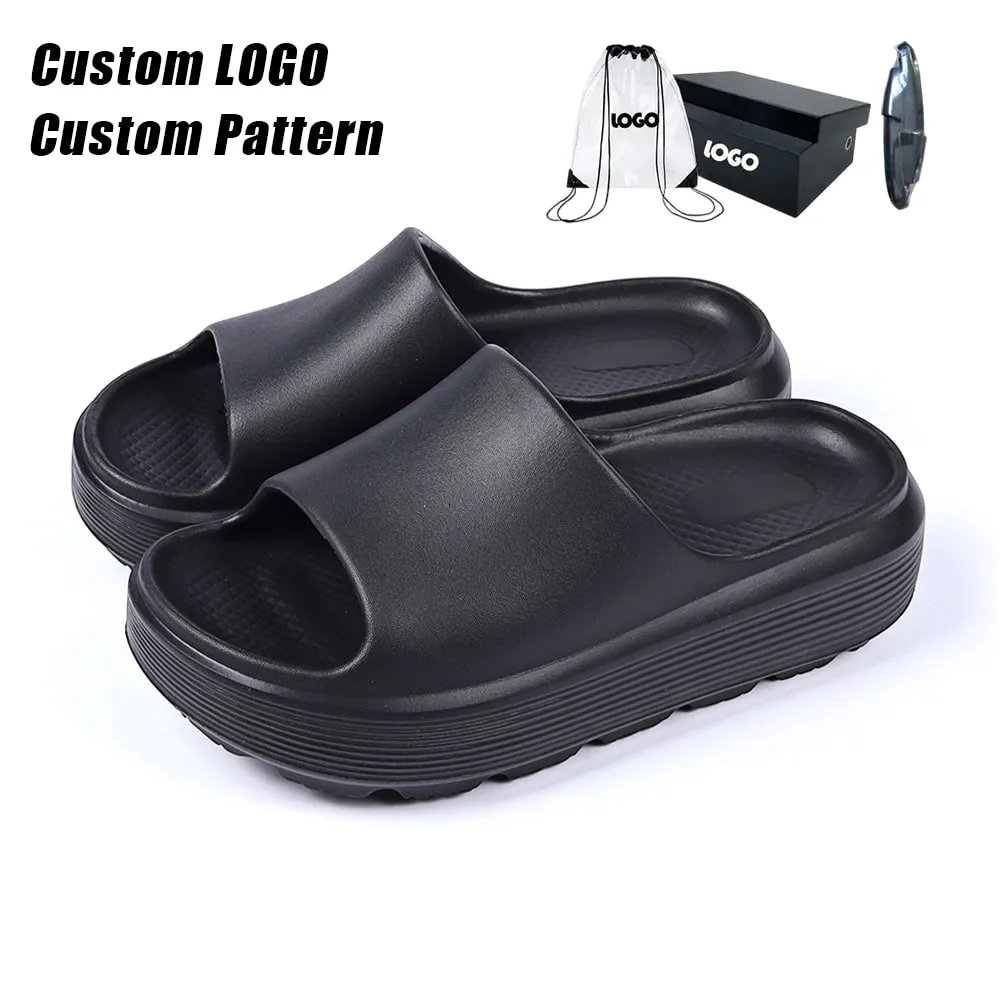
Demand is concentrating in five families: one-piece molded EVA slides, thick-sole pillow styles, plush house slippers, hotel guest slippers, and outdoor casual slides. The first two are growing fastest in direct-to-consumer and resort retail, while the last remains the price-driven supermarket layer.
Slippers moved from household necessity to comfort product with a visible brand surface, so buyers now ask about density and outsole geometry rather than colour cards.
Trending Styles and What They Cost to Customize
| Style | Core construction | Customization difficulty | Typical channel |
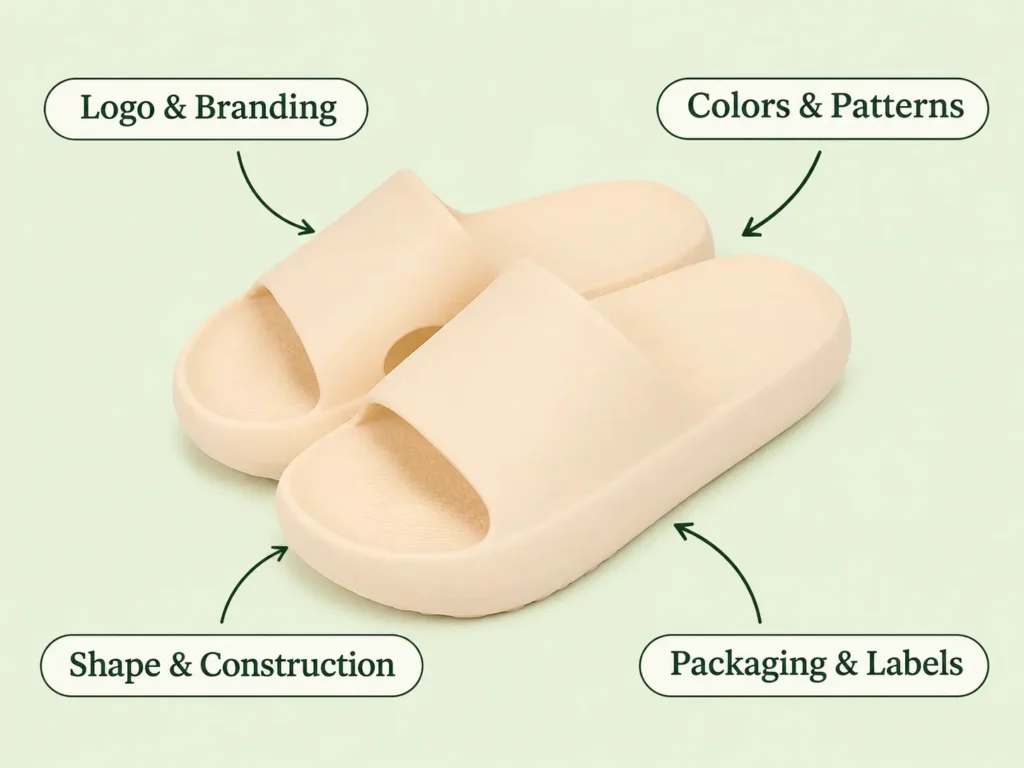
| One-piece molded EVA slide | Single-density EVA, 3 to 8 mm sole | Low: colour, texture, in-mold logo | DTC, resort retail |
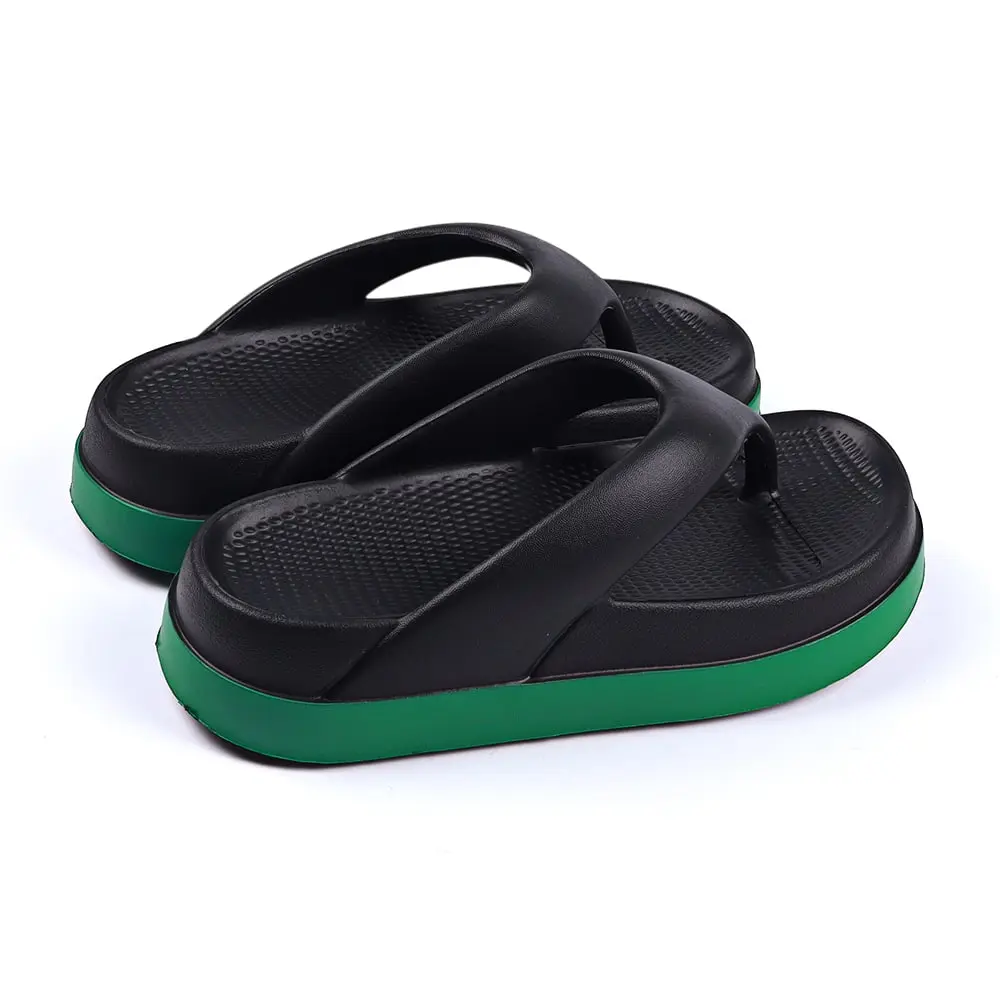
| Thick-sole pillow slide | Soft EVA top layer on firmer outsole | Medium: two-part build, surface printing | Fashion e-commerce, gifting |
| Plush house slipper | Textile upper, TPR or EVA outsole | Medium to high: fabric, embroidery, lining | Retail, winter gifting |
| Hotel guest slipper | Terry or non-woven upper, 3 to 4 mm sole | Low to medium: logo, polybag, size spread | Hospitality, spa |
| Outdoor casual slide | EVA or PVC, textured outsole | Low: colour, print, hardness tuning | Beach, supermarket |
Reading a Trend Without Overcommitting
Two or three styles at 300 to 500 pairs each, with variety carried by size ratio rather than colour count, keeps per-colour minimums intact and produces a real sell-through figure. Six colourways of one unproven silhouette turn a test into inventory.
How to Make Personalized Slippers
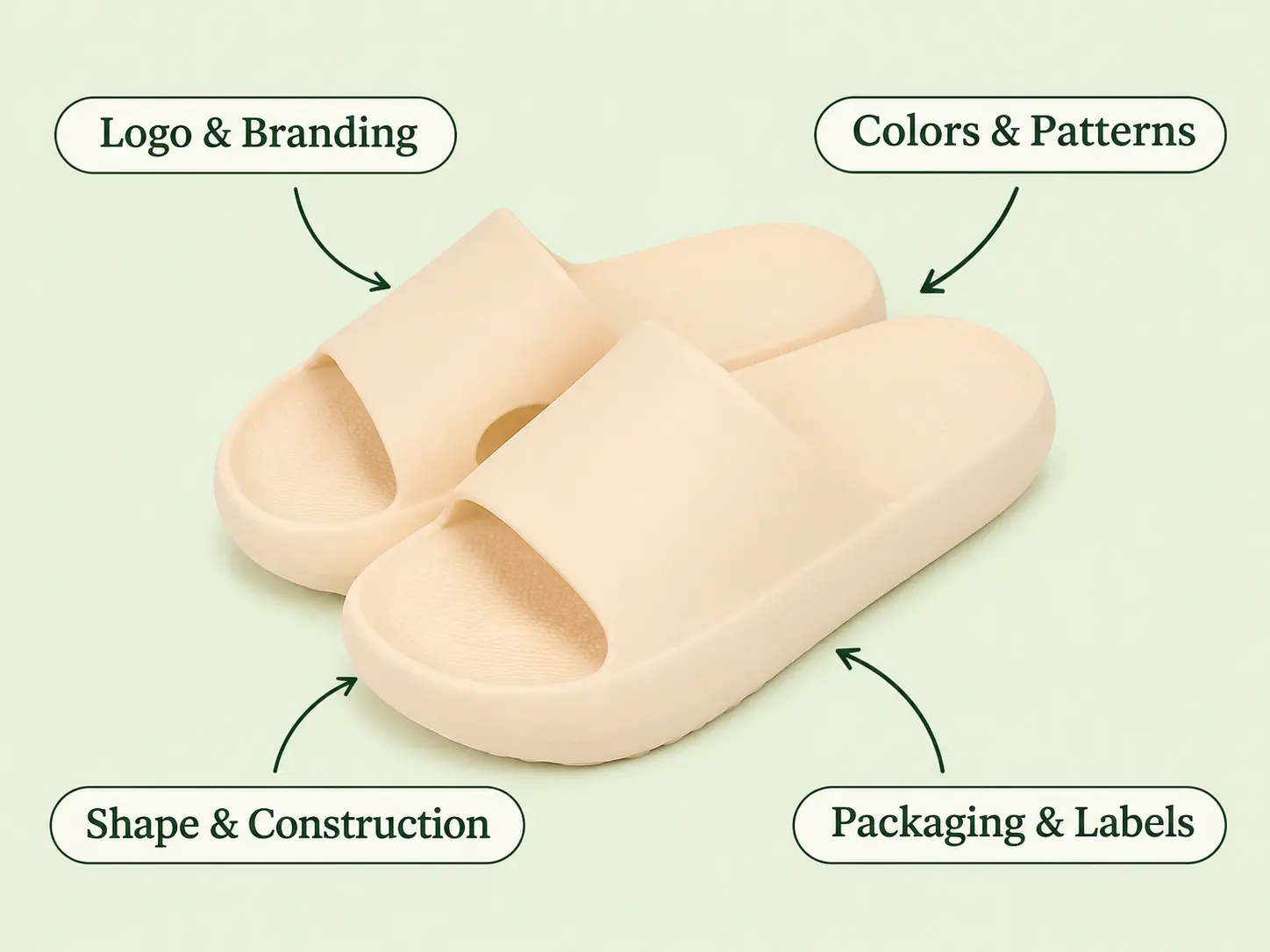
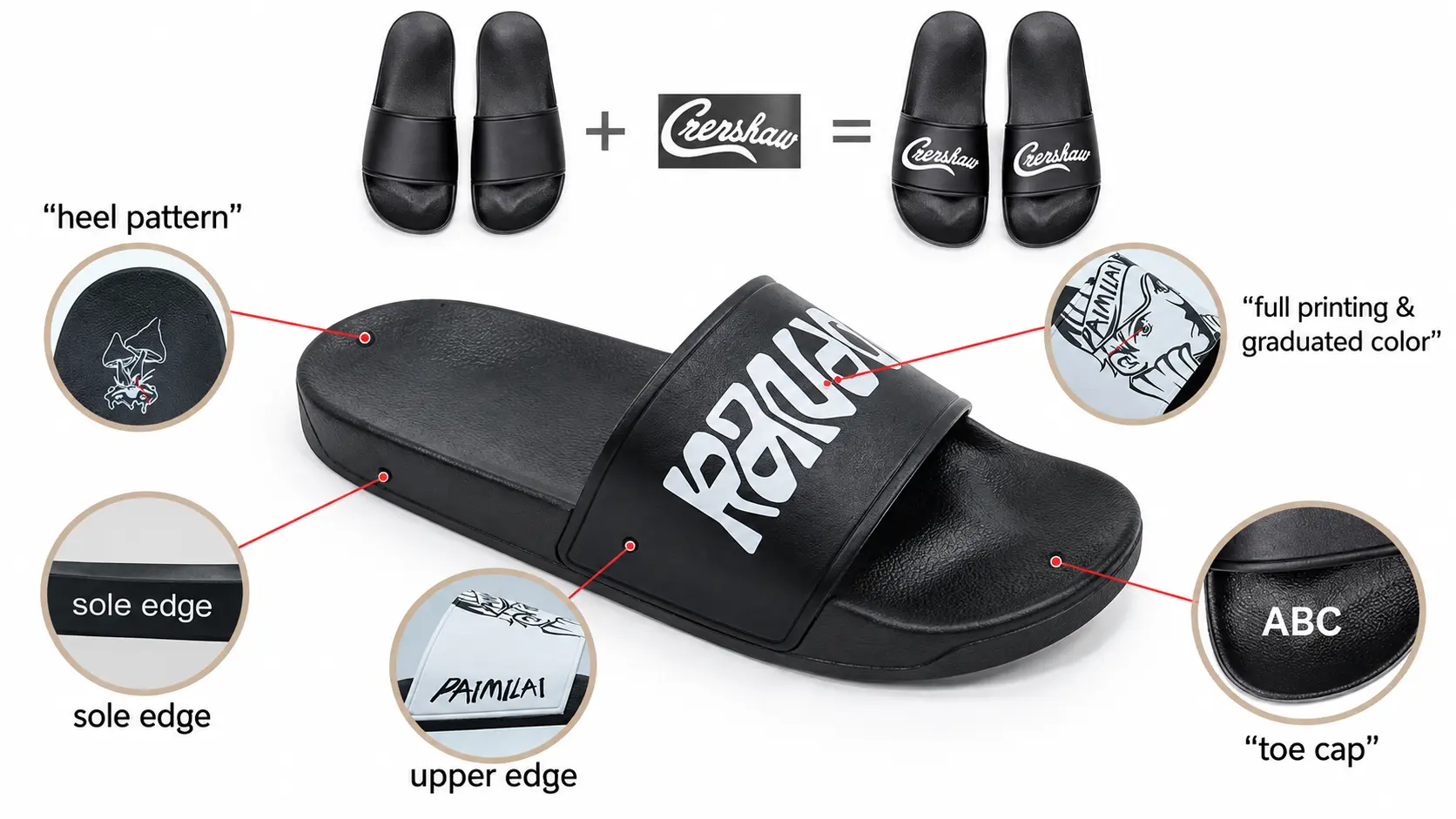
Personalized slippers combine three independent layers: decoration on the product, branding on the packaging, and shape from the tooling. Each carries its own minimum, cost adder and failure mode, so each should be specified and priced separately.
Decoration is where the gap between a sample and a reorder appears first. A print that looks crisp on an approved pair can crack at the fold after ten laundry cycles, which is acceptable for a single-use guest slipper and unacceptable for retail.
Decoration Methods Compared
| Method | Added cost per pair | Practical minimum | Durability |
| In-mold logo | 0.15 to 0.35 USD | 1,000 to 2,000 pairs | Life of the product |
| Screen print | 0.08 to 0.20 USD | 300 pairs | Cracks after 10 to 15 washes |
| Heat transfer | 0.10 to 0.25 USD | 300 to 500 pairs | Fades with abrasion |
| Embroidery | 0.25 to 0.60 USD | 300 to 500 pairs | 30 or more washes |
| Woven label | 0.04 to 0.10 USD | 300 pairs | Permanent |
Match the method to the wash cycle rather than to the artwork. Anything expected to survive laundering belongs in in-mold, embroidery or a sewn label; anything intended for one evening can be printed.
Packaging as Part of the Product
Four formats cover most orders: polybag, printed colour box, non-woven pouch, and a hospitality set of slipper, pouch and card. Freight is where the decision gets expensive. At 60 pairs per carton of 50 by 40 by 30 cm, a 20-foot container absorbs about 400 to 460 cartons, or 24,000 to 27,000 pairs. Boxing each pair can cut that density by 30 to 40 percent.
Tooling, Ownership and the Second Order
Tooling decides whether the second order is cheap or starts again from zero. Three points belong in writing before the deposit: mold cost quoted apart from the unit price, who owns the mold and whether it can be transferred, and whether the fee is amortized, credited at a volume threshold, or paid once and retained. A buyer who pays without an ownership clause is renting someone else’s asset.
The Tech Pack: Turning a Custom Brief Into Inspectable Numbers
A tech pack is the document that makes a custom order inspectable. It states each performance parameter as a number with a tolerance, shows where that number is measured, and lists the artwork, packaging and test requirements, so the sample, the production run and the inspection report are all judged against one sheet instead of against adjectives.
Vague briefs produce vague goods. A supplier told to make a slipper that feels soft but supportive has no way to fail, and the buyer has no way to prove a failure. The pack converts both into measurements, and it usually decides whether a reorder matches the first shipment.
Six Specifications That Must Be Written Down
| Parameter | Typical range | Why it belongs in the pack |
| Foam density | 0.12 to 0.18 g/cm3 | Drives compression set and useful life, and is the most commonly omitted |
| Sole thickness | 3 to 12 mm by use case | Sets perceived value and abrasion life |
| Hardness | Shore C 35 to 50 | Balances grip on wet tile against underfoot support |
| Upper weight | 180 to 320 g/m2 | Determines warmth and wash durability |
| Single-pair weight | 120 to 300 g | Feeds the freight and carton calculation |
| Colour tolerance | Within 1.5 units of the swatch | Protects reorder matching across dye lots |
Hardness deserves a method rather than a figure typed on a sheet. ASTM D2240 defines how a durometer reading is taken, including which scale and what specimen condition, and a supplier unable to say which scale produced a number has not measured anything reproducible.
Where to Measure, and What Tolerance to Allow
- Footbed length at the centreline, heel to toe, not diagonally
- Sole thickness at the heel and the forefoot, never at the arch
- Hardness on a finished pair, not on a raw slab
- Colour on the upper and the outsole separately
Each point belongs on a drawing with arrows and a stated tolerance, typically plus or minus 1.5 mm on footbed length and 2 mm on sole thickness. Programs sourcing through an EVA custom slippers line usually receive these values already tabulated, which shortens the first approval round.
What Else Belongs in the Pack
Vector artwork with Pantone references, the packaging dieline and material, the quantity breakdown per size, the test list the destination market requires, and the criteria that define a pass at inspection. Anything left out of the pack cannot be enforced afterwards.own sell-through history.
Where to Buy Wholesale Slippers
Wholesale slippers come from five sources: a factory that owns its molds, a trading company, a business-to-business marketplace, a regional distributor, and a brand’s wholesale program. Order size and customization depth decide which one is rational.
Below roughly 300 pairs, setup work rarely pays and distributor stock is the sane entry. Above 20,000 pairs, the question becomes capacity rather than price.
Five Sourcing Channels Compared
| Channel | Typical first order | Customization freedom | Main risk |
| Factory direct | 500 to 1,000 pairs per style | High, including tooling | More sampling work up front |
| Trading company | 300 to 500 pairs | Moderate | Specification drift after quotation |
| B2B marketplace | 100 to 500 pairs | Low to moderate | Inconsistent quality between sellers |
| Regional distributor | 50 to 200 pairs | Very low | Narrow range, distributor margin |
| Brand wholesale program | Case packs | None | No spec control, no exclusivity |
What to Verify Before Paying for Samples
- The registered business scope, to confirm the supplier manufactures footwear rather than resells it.
- The factory’s own mold list, so the quoted style is not being subcontracted.
- Restricted substance test reports, current within twelve months.
- Two references in a comparable channel, ideally one reorder customer.
- Whether the sample fee is credited against the first bulk order.
MOQ, Cost Adders and Lead Time
The unit price on a quotation is a base cost plus adders, and the adders are where quotes actually differ. Material grade, decoration, packaging, tooling, testing and sampling move independently, so two quotes for the same style can differ by 40 percent without either supplier being dishonest.
Minimums apply per style and per colour rather than per purchase order, which is why moving from 400 to 800 pairs often reduces risk more than negotiating hard at 400.
The Cost Stack of a Custom Order
| Cost element | Typical range | What drives it |
| Base material | 1.15 to 3.90 USD per pair | Resin grade, density, upper weight |
| Decoration | 0.03 to 0.60 USD per pair | Method and print positions |
| Packaging | 0.03 to 0.35 USD per pair | Polybag versus rigid box |
| Tooling | 400 to 1,500 USD one time | Sole complexity and size count |
| Testing | 150 to 600 USD per order | Market requirements, test count |
| Sampling | 50 to 150 USD per style | Development rounds |
Material accounts for 55 to 62 percent of factory cost, labour 15 to 18 percent and packaging 8 to 10 percent. A quote that undercuts the market by a third has moved one of those three, and the MOQ and lead time terms are where to check how.
Timeline From Artwork to Delivery
- Brief and specification, one week
- Quotation and sample request, two to four days
- Sampling, 7 to 12 days on an existing mold, 20 to 35 days with new tooling
- Sample approval and revision round, one week
- Bulk production, 20 to 35 days
- Inspection, two to three days
- Ocean transit, 18 to 38 days by route
A buyer who needs stock in week twelve has to approve a sample in week one.
Quality Control and Compliance for Decorated Slippers
In a decorated slipper, the decoration fails before the construction does. Colour drift against the swatch, poor ink adhesion at the flex point and adhesive odour account for most rejections, and all three are visible at a first-carton inspection if the checklist names them.
Inspection should run twice: when the first cartons are packed, which catches systematic faults while correction is still possible, and before shipment, which confirms the order is consistent.
Inspection Points That Matter
- Colour match to the approved swatch under standard lighting
- Adhesion at the fold, checked by flexing the decorated area rather than by eye
- Rub and wash resistance on a sample drawn from production, not from the approval set
- Odour after 24 hours out of the polybag
- Sole hardness within the agreed Shore C range, typically 35 to 50
- Footbed length per size, measured rather than assumed from the label
- Slip performance on wet tile, measured with a whole-shoe friction test such as ASTM F2913 rather than claimed as non-slip
Documentation for Regulated Markets
Buyers importing into the European Union need restricted substance documentation covering inks, adhesives and recycled content, because decoration introduces chemistry a plain sole does not. North American importers need correct country of origin marking and, for children’s sizes, attention to small components. Every market needs a composition and care label matching what actually shipped.
Launching a Custom Slippers Program in Six Steps
- Define the end use and service life, then write the specification as numbers: density, thickness, hardness, upper weight, size ratio.
- Choose the customization level that matches the volume, and price tooling apart from unit cost.
- Request samples in the core size, in the exact decoration method being quoted.
- Run the five supplier checks above, and settle mold ownership in writing.
- Order in the volume band that earns the price you modelled, with inspection scheduled twice.
- Keep the approved sample, specification sheet and inspection report, because the third order is where consistency is won or lost.
FAQ
What file format should I send for logo and artwork?
Vector files: AI, EPS or a clean PDF with outlined text. Vector artwork scales to a mold engraving or a screen without redrawing, while a PNG has to be traced, and tracing changes letterforms. Send colour references as Pantone numbers, and ask for a physical proof on the actual material before production.
How do I stop my design from being resold to other buyers?
Three mechanisms work together. An exclusivity clause should name the style, the mold and the territory, with a duration. Mold ownership should sit with the buyer where tooling was paid for. A trademark registered in the manufacturing country closes the gap an NDA leaves, because it gives grounds to stop production rather than only to claim damages.
Are sampling and tooling fees refundable?
It depends on structure, and the structure belongs in the quotation rather than agreed later. Sampling fees are commonly credited against the first bulk order above a stated quantity. Tooling is either amortized across the first order, credited at a volume threshold, or paid outright with ownership transferring to the buyer.