Heat Transfer Printing for Custom Slippers: Best 7-Step Guide
Heat Transfer Printing is a reliable customization method for brands.
It supports detailed, colorful, and visually attractive logos or graphics on slippers.
Screen Printing and Laser Carving are simpler branding methods.
Heat Transfer Printing for slippers is especially useful for multi-color designs.
It also works well for detailed artwork, decorative graphics, and other complex brand elements.
Footwear brands, online sellers, retailers, promotional companies, and importers can use this process.
It turns standard slippers into customized branded products.
A one-pair sample can be reviewed before a larger order is planned.
At Yuchuang Shoes, we offer Heat Transfer Printing as one of our main slipper printing services.
Our customized slipper service can start from just 1 pair.
Buyers can test a logo, develop a sample, prepare product photography, or evaluate a new design before larger production.
This guide explains the process, suitable logos, alternative methods, and buyer preparation.
What Is Heat Transfer Printing?
For heat transfer printing for custom slippers, controlled heat and pressure transfer a prepared graphic or logo onto a suitable product surface.
For custom footwear, the artwork is prepared first and then transferred onto the slipper surface using heat and pressure.
This heat transfer printing for custom slippers process can be used for:
- Brand logos
- Company names
- Multi-color graphics
- Decorative artwork
- Promotional designs
- Custom patterns
- Personalized graphics
Laser Carving creates a more integrated and minimal branding effect.
Heat Transfer Printing adds a visible graphic to the slipper surface.
Compared with traditional Screen Printing, Heat Transfer Printing offers greater flexibility.
It can reproduce designs with more colors and finer details.
Why Use Heat Transfer Printing for Custom Slippers?
For brands comparing customization options, heat transfer printing for custom slippers offers a practical balance of color and detail.
This suits branded projects with clear artwork requirements.
It also supports small-batch flexibility.
The main advantage of Heat Transfer Printing is its ability to combine good visual detail with multiple colors.
For many brands, this makes it a practical choice between simple Screen Printing and more complex Digital Printing.
1. Suitable for Multi-Color Logos
Many modern brand logos are no longer limited to one or two solid colors.
They may include:
- Several brand colors
- Decorative details
- Small graphic elements
- Layered designs
Heat Transfer Printing suits complex logo designs.
It can reproduce more detailed artwork than basic Screen Printing.
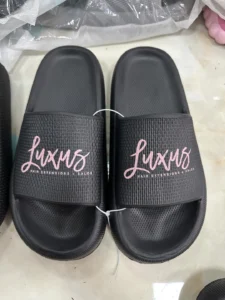
For buyers developing custom slippers with logo, this provides more freedom.
It helps create a recognizable brand identity.
2. Good Detail Reproduction
Heat Transfer Printing can reproduce relatively detailed artwork with clean edges.
This is useful for:
- Detailed logos
- Brand graphics
- Decorative symbols
- Small design elements
- Promotional artwork
If your logo contains more detail than a typical Screen Printing design, Heat Transfer Printing may provide a better result.
3. Attractive Decorative Effect
Not every slipper project is based on a simple brand name.
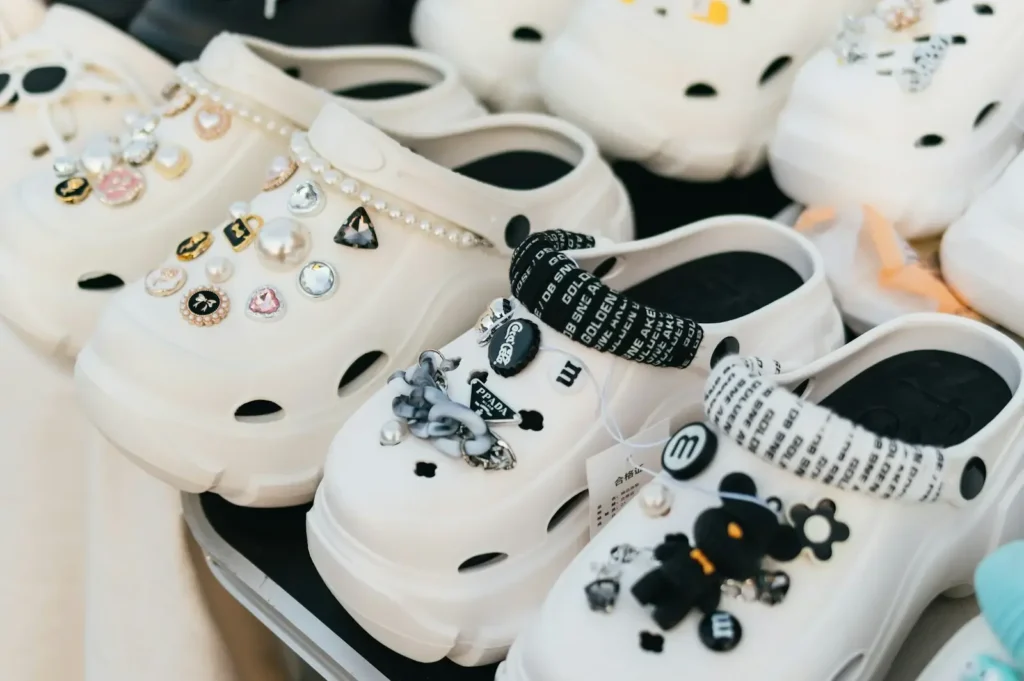
Some buyers want the footwear itself to look more decorative and visually distinctive.
Heat Transfer Printing can add these visual elements:
- Colorful logos
- Decorative graphics
- Fashion elements
- Promotional designs
- Seasonal artwork
This can help standard slipper styles look more customized.
4. Suitable for Product Testing
At Yuchuang Shoes, custom slipper orders can start from 1 pair.
This allows buyers to test heat transfer printing for custom slippers before committing to larger production.
A one-pair sample can be used to check:
- Logo color
- Artwork clarity
- Logo size
- Position
- Overall appearance
This is especially useful for:
- Startups
- New footwear brands
- Amazon sellers
- Shopify sellers
- Retail buyers
- Promotional projects
- Product photography
- Market testing
What Types of Slippers Can Use Heat Transfer Printing?
Heat transfer printing for custom slippers can suit different slipper styles.
The final choice depends on the material and product surface.
Possible applications include:
- EVA slides
- Flip flops
- Indoor slippers
- Outdoor slippers
- Fashion slippers
- Promotional slippers
- Other suitable footwear styles
However, not every surface is suitable for Heat Transfer Printing.
The final feasibility depends on these factors:
- Material
- Surface texture
- Shape
- Printing area
- Heat resistance
- Logo position
- Product construction
Before production, the slipper should be evaluated to determine whether Heat Transfer Printing is the right customization method.
Where Can Heat Transfer Printing Be Used on Slippers?
The best logo position depends on the structure of the product.
Upper
The upper is one of the most common areas for custom slipper branding.
For suitable slipper styles, Heat Transfer Printing can be used to create:
- Brand logos
- Decorative graphics
- Multi-color designs
A larger upper area also gives buyers more space for creative artwork.
Strap
The strap of a slide or slipper can also be an effective branding position.
It may be suitable for:
- Brand names
- Multi-color logos
- Small decorative artwork
Footbed
Some slipper designs may allow Heat Transfer Printing on the footbed.
This position can be used for:
- Brand graphics
- Promotional artwork
- Decorative designs
Other Suitable Areas
Depending on the footwear structure, other flat or suitable surfaces may also be considered.
The manufacturer should evaluate the product before confirming the printing position.
What Type of Logo Is Best for Heat Transfer Printing?
Heat Transfer Printing is particularly useful for designs that are more complex than a basic one-color logo.
Suitable Designs
It works well with:
- Multi-color logos
- Detailed brand graphics
- Decorative artwork
- Small illustrations
- Promotional graphics
- Fashion designs
- Custom patterns
If your branding depends on color and graphic detail, Heat Transfer Printing can be a good option.
When Another Method May Be Better
Heat Transfer Printing is not always necessary.
If your logo is only:
- A simple brand name
- One-color text
- A basic symbol
- A minimalist logo
then Screen Printing or Laser Carving may be more practical.
If the design contains:
- Full-surface artwork
- Very complex illustrations
- Extensive gradients
- Highly detailed patterns
Digital Printing may also be worth considering.
The best method depends on the slipper surface and the desired final effect.
Heat Transfer Printing vs Screen Printing
Heat Transfer Printing and Screen Printing are both commonly used for custom logo slippers, but they are suitable for different design styles.
| Feature | Heat Transfer Printing | Screen Printing |
|---|---|---|
| Best For | Detailed and multi-color logos | Simple logos |
| Colors | Multiple colors | Mainly solid colors |
| Detail | Higher | Better for simple graphics |
| Appearance | Decorative and precise | Clean and direct |
| Design Flexibility | Higher | More limited |
Choose Heat Transfer Printing when:
- Your logo contains multiple colors
- The artwork has more detail
- Decorative effects are important
- You want a more complex printed design
Choose Screen Printing when:
- The logo is simple
- The design uses one or two colors
- You want clear and direct branding
Heat Transfer Printing vs Laser Carving
Laser Carving and Heat Transfer Printing create very different visual effects.
Laser Carving is more suitable for minimal, integrated branding.
Heat Transfer Printing is better when color and visible graphics are important.
Choose Heat Transfer Printing when:
- You want a colorful logo
- The design contains graphic details
- The branding should be visually noticeable
Choose Laser Carving when:
- Your logo is simple
- You prefer a minimal appearance
- You want the branding to blend into the product
- Color is not important
For EVA clogs and molded EVA slippers, both methods may be considered depending on the product structure and design.
Heat Transfer Printing vs Digital Printing
Heat Transfer Printing and Digital Printing can both support more detailed and colorful designs.
The difference depends largely on the product, artwork, and required visual effect.
| Feature | Heat Transfer Printing | Digital Printing |
|---|---|---|
| Multi-Color Logo | Yes | Yes |
| Detailed Graphics | Good | Very good |
| Gradient Designs | Possible depending on artwork | Better suited |
| Complex Patterns | Suitable | Highly suitable |
| Best Use | Logos and decorative graphics | Full-color artwork and complex patterns |
Choose Heat Transfer Printing when:
- The design is colorful but not extremely complex
- You want detailed logo graphics
- The product surface is suitable for transfer printing
Choose Digital Printing when:
- The artwork is very complex
- Full-color patterns are required
- Gradients and illustrations are important
- You need more creative freedom
Can You Make a Heat Transfer Printing Sample First?
Yes.
At Yuchuang Shoes, our customized slipper service can start from just 1 pair.
For new projects, making one sample first is often the most practical approach.
The sample allows you to check:
- Logo size
- Logo color
- Artwork details
- Printing position
- Overall appearance
A sample can also be used for:
- Product photography
- Online listings
- Trade shows
- Buyer presentations
- Social media
- Internal approval
- Market testing
After the Heat Transfer Printing sample is approved, buyers can decide whether to move forward with larger production.
What Information Should You Provide for Heat Transfer Printing?
To evaluate a Heat Transfer Printing slipper project, buyers should provide several basic details.
1. Slipper Style
Send the product you want to customize.
For this process, you can provide:
- Product number
- Product link
- Product photo
- Reference image
This allows the manufacturer to evaluate the material and printing surface.
Include your logo file and sample requirements for heat transfer printing for custom slippers.
2. Logo or Artwork File
A clear artwork file is important for Heat Transfer Printing.
Recommended file formats include:
- AI
- EPS
- SVG
- PSD
- High-resolution PNG
Vector files are preferred for logos whenever possible.
For detailed artwork, high-resolution images are recommended.
3. Logo Position
Tell us where you want the Heat Transfer Printing design to appear.
Common positions may include:
- Upper
- Strap
- Footbed
- Other suitable areas
If you are unsure, we can evaluate the product and recommend an appropriate position.
4. Logo Size
Provide an approximate size if possible.
For example:
- 30 mm wide
- 50 mm × 20 mm
- Full strap area
The final size can also be adjusted according to the slipper dimensions.
5. Color Requirements
If your brand uses specific colors, you can provide reference colors or Pantone information.
Confirm the result with a sample when color accuracy matters.
For footwear buyers, ISO 17700:2019 colour-fastness testing for footwear uppers is a useful reference.
It covers rubbing and transfer evaluation.
It also helps buyers consider bleeding performance before approving a sample.
6. Quantity
Tell us how many pairs you need.
Our custom slipper service can start from 1 pair.
This makes it easier to test the transfer result before larger production.
Step-by-Step Heat Transfer Printing Process
This heat transfer printing for custom slippers process is straightforward.
Step 1: Choose the Slipper
Select the slipper style you want to customize.
Step 2: Send Your Logo or Artwork
Provide the design file, preferred position, and color requirements.
Step 3: Evaluate the Product
We evaluate:
- Material
- Surface
- Printing area
- Logo design
to determine whether Heat Transfer Printing is suitable.
Step 4: Confirm Logo Size and Position
Before production, confirm the artwork dimensions and final placement.
Step 5: Make a Sample
Because customization can start from 1 pair, buyers can first make a Heat Transfer Printing sample.
Step 6: Check the Result
Review:
- Color
- Detail
- Position
- Size
- Overall appearance
Step 7: Start Larger Production
After sample approval, production can proceed according to the confirmed project requirements.
Is Heat Transfer Printing Right for Your Brand?
Heat Transfer Printing may be a good choice if:
- Your logo contains multiple colors
- The artwork has detailed elements
- You want a more decorative branding effect
- Simple Screen Printing is not enough
- You want to test a custom design in a small quantity
- The slipper surface is suitable for heat transfer
Another method may be better if:
- Your logo is extremely simple
- You only need one solid color
- You prefer minimal branding
- You need very complex full-surface artwork
For simple branding, consider Screen Printing or Laser Carving.
For highly complex full-color designs, Digital Printing may be more suitable.
Can Heat Transfer Printing Be Combined With Other Customization?
Yes.
Heat Transfer Printing can be combined with other custom slipper services, including:
- Custom slipper colors
- Custom strap colors
- Custom packaging
- Hang tags
- Labels
- Polybags
- Custom boxes
- Carton marks
For buyers who need a completely unique shoe structure, private mold development can also be considered.
Brands can combine customized logos, colors, and packaging.
They can also develop a complete footwear design project.
Frequently Asked Questions About Heat Transfer Printing
What is Heat Transfer Printing for slippers?
Heat Transfer Printing uses controlled heat and pressure to transfer a prepared logo or graphic onto a suitable slipper surface.
It is commonly used for detailed and multi-color branding.
What slippers can use Heat Transfer Printing?
Suitable styles include EVA slides, flip flops, and indoor slippers.
Outdoor, fashion, and promotional slippers may also work when the surface is suitable.
The product should be evaluated before production.
Is Heat Transfer Printing suitable for multi-color logos?
Yes.
One of the main advantages of Heat Transfer Printing is its ability to reproduce multi-color and more detailed logo designs.
Is Heat Transfer Printing better than Screen Printing?
Neither process is always better.
Screen Printing is more suitable for simple, solid-color logos.
Heat Transfer Printing is generally better for more detailed or multi-color graphics.
Heat Transfer Printing or Digital Printing: which should I choose?
Choose Heat Transfer Printing for detailed logos and decorative graphics.
Choose Digital Printing when the artwork contains more complex patterns,
extensive gradients, or full-color illustrations.
Can I order one sample first?
Yes.
Our customized slipper service can start from 1 pair, allowing you to test the Heat Transfer Printing result before larger production.
What files should I send?
AI, PDF, EPS, SVG, PSD, or high-resolution PNG files are commonly suitable for evaluation.
For a practical starting point, this guide helps buyers compare materials and artwork.
It also helps them review sample results before production.
Start Your Heat Transfer Printing Slipper Project
Heat Transfer Printing for custom slippers is a practical choice for brands that need colorful, detailed, and professional-looking graphics.
It is especially suitable for:
- Multi-color logos
- Detailed brand graphics
- Decorative artwork
- Promotional designs
- Fashion slipper projects
- Small-quantity product testing
At Yuchuang Shoes, we support Heat Transfer Printing together with other slipper logo customization methods, including:
- Laser Carving
- Screen Printing
- Digital Printing
Our customized slipper service can start from just 1 pair.
If you want to develop custom slippers with Heat Transfer Printing, simply send us:
- The slipper style
- Your logo or artwork file
- Preferred printing position
- Approximate logo size
- Color requirements
- Required quantity
We can evaluate your product and recommend a suitable Heat Transfer Printing solution.
For brands planning heat transfer printing for custom slippers, send your requirements for a practical review.
Looking for a custom slipper manufacturer for heat transfer printing for custom slippers?
Send us your logo and slipper requirements to start the project.