Sourcing slippers for a brand, a hotel group, or a retail chain begins with a sample request before any production commitment. Yet the quote that comes back is rarely one clean number: one supplier asks for a sample fee, another mentions a mold fee, and a third offers a free sample if freight is covered. For procurement teams building a landed-cost model, that inconsistency causes most of the early confusion.
A custom slipper sample typically costs between USD 30 and USD 150 per pair, plus courier charges, and the span comes down to one variable: how far the sample sits from a standard design. A stock style on an existing mold is often free with the buyer covering freight only. A light customization such as a printed or embroidered logo on an existing mold usually costs roughly USD 50 to USD 120 per style. A full custom development requiring a new mold can run from a few hundred to nearly two thousand US dollars, because what you are paying for is tooling rather than the pair itself. In most cases the sample fee is credited back against the bulk order; the mold fee generally is not.
This guide breaks that quote down line by line, so your next sample request comes back as a number you can plan around.
How Much Does a Custom Slipper Sample Cost?
There is no universal price, but there is a predictable pattern: sample cost rises with customization depth and falls as committed volume rises. Expect free samples with freight only for stock styles, roughly USD 50 to USD 120 for logo or color work on an existing mold, and USD 300 to USD 1,950 or more when a new mold must be engineered.
Sample pricing is not a profit center; it recovers the cost of a prototype produced by hand, outside the normal production flow. Every experienced slippers manufacturer prices that recovery differently, which is why two factories can quote the same project at USD 60 and USD 400 without either being dishonest.
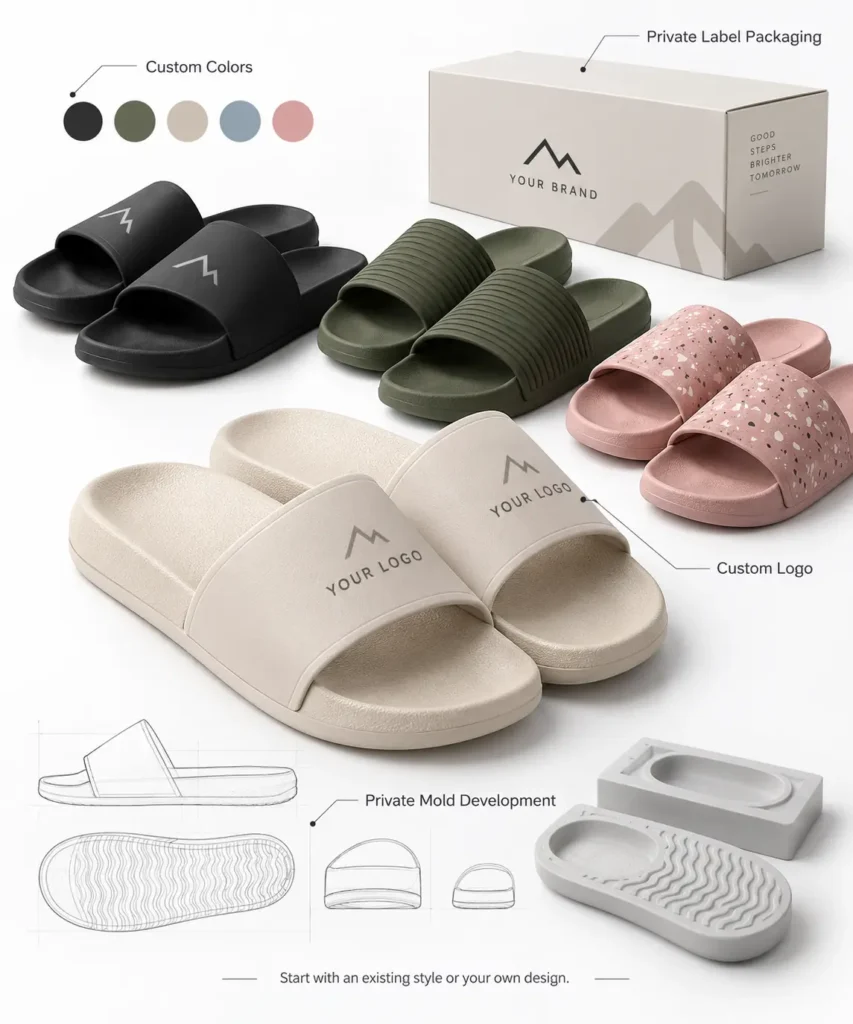
Typical Sample Fee Ranges by Customization Level
| Order type | Sample fee | What it covers | Sampling time |
| Stock style, no changes | Free, freight paid by buyer | Existing mold, materials, and colorways | 3 to 5 days |
| Light customization, such as a logo or a new color | USD 50 to USD 120 per style | Plate making or digitizing, material matching, one sample pair | 5 to 7 days |
| Full custom OEM with new tooling | USD 300 to USD 1,950 or more | New mold, pattern engineering, color development | 20 to 30 days |
A stock sample is a warehousing exercise, a light customization sample is a decoration trial, and a full custom sample is a product development project.
What the Sample Fee Actually Covers
A sample is the most expensive pair a factory will ever make, because nothing about it is optimized. A typical fee bundles:
- Materials bought in small lots rather than full rolls or resin batches, removing volume discounts
- Manual cutting, stitching, and finishing by a technician instead of a production line
- Plate making, screen preparation, or embroidery digitizing when a logo is involved
- Craft trials, including test prints and bonding tests on new material combinations
- Color matching, approval photos, export packing, and courier dispatch
When a factory quotes a low fee, one of those lines is absorbed in bulk pricing or a larger minimum order.
Why a Sample Costs Far More per Pair Than Bulk
Bulk pricing spreads fixed costs across thousands of units, while a single sample carries the whole burden alone. Machine setup, mold mounting, and color adjustment are one-time costs that a 2,000-pair order divides by 2,000 and a one-pair sample by one. Labor is slower too: a technician checking dimensions by hand may spend hours on a pair a production line turns out in seconds. The useful comparison is not sample cost against bulk cost, but sample cost against project risk.
What Drives the Cost of a Custom Slipper Sample?
Four factors account for nearly all of the variation: material and construction, the logo or decoration method, whether new tooling is required, and how many variants you request. Removing any one of them typically moves the quote by a recognizable step.
Material and Construction
Material choice is the first cost lever. A single-density injection-molded ethylene-vinyl acetate slipper needs one material and one processing step, while a laminated or plush-lined construction adds a second material, an adhesive system, and a bonding trial. Fabric-based slippers add cutting, lining, and sewing. Density matters as much as type, since higher-density foam uses more compound per pair. Buyers building a foam-based range should confirm material data and tooling capability together, which is where a dedicated EVA Custom Slippers Manufacturer removes the guesswork.
Logo and Decoration Method
Decoration creates a clear cost ladder, and it is often the largest line item in a light customization quote:
- Screen printing: lowest cost at volume, but each color needs its own screen
- Heat transfer and digital printing: suited to photographic artwork, no per-color setup
- Hot stamping and foil printing: premium appearance, higher setup
- Embroidery: durable and tactile, but requires digitizing, a one-time engineering charge
- Laser engraving and molded-in logos: no consumables, but they tie the logo to the mold
Choosing a method that suits the mold keeps a sample quote predictable.
New Mold and Plate-Making Requirements
A plate-making charge is minor, generally tens of dollars per style for a print screen or embroidery plate. A mold is not. Developing a new mold turns the project into a tooling investment, and the fee reflects design, machining, and trial shots. Adapting an existing mold with a new colorway delivers most of the branding benefit at a fraction of the cost. If a new shape is unavoidable, treat the mold as a capital asset and negotiate ownership in writing.
Sample Variants, Sizes, and Colorways
Each additional variant is close to a separate sample in effort, even at a discount. Two colorways, three sizes, and a revised round can multiply a base fee several times over. Most buyers sample one reference size, confirm the construction, and rely on written specifications for the rest.
Sample Fee vs. Mold Fee: What Is the Difference?
A sample fee pays for a prototype: a development and validation charge normally credited back against the bulk order. A mold fee pays for tooling: a one-time capital cost generally not credited back and invoiced separately. A full custom project triggers both.
What the Sample Fee Pays For
The sample fee buys a physical object you can inspect, test, and approve, covering the labor and materials consumed in building it. Because the factory expects to recover it through your bulk order, it is often presented as a deduction rather than standalone revenue.
What the Mold Fee Pays For
The mold fee buys the tool itself. A mold may be machined from metal for high-volume injection moulding or produced as a simpler tool for lower-volume work. The cost is driven by engineering hours, machining, and trial iterations, and it is incurred once; after that the tool produces order after order with no further charge.
How the Two Interact by Order Type
| Order type | Sample fee | Mold fee | Deductible from bulk |
| Stock style, existing mold | Free, freight only | None | Not applicable |
| Light customization, existing mold | USD 50 to USD 120 per style | None, though plate-making of about USD 40 to USD 60 per style applies to print or embroidery work | Sample fee usually yes, plate fee usually no |
| Full custom OEM, new tooling | USD 300 to USD 1,950 or more | About USD 450 to USD 750 for PVC and USD 1,700 to USD 1,950 for EVA, per size | Sample fee yes, mold fee no, with ownership in writing |
Confusing a deductible sample fee with a non-deductible mold fee is the most expensive misunderstanding here, because the two can differ by an order of magnitude. Buyers exploring heavier customization should review Private Mold Slippers terms before approving tooling, since ownership, storage, and reuse are negotiated alongside the price.
Which Fee Can Be Deducted from the Bulk Order
Development charges attached to a specific order are normally deductible; tooling charges attached to a physical asset are not. A reasonable position is to ask for full deduction of the sample fee against a stated minimum order quantity, and for written confirmation of mold ownership and storage duration.
Is the Custom Slipper Sample Fee Refundable?
Usually it is not refunded in cash. The common arrangement is a credit or deduction applied to your first bulk order once it reaches an agreed quantity. Cash refunds exist but are the exception, and they are almost always tied to a minimum order value. Mold fees sit outside this arrangement and are treated as non-refundable capital expenditure.
Refund, Credit, and Waived: Three Different Policies
The three words are used loosely in quotations, and the difference matters:
- Waived: the sample is free, with the buyer paying freight only, typical for stock styles
- Credited or deducted: the fee is charged up front, then subtracted from the bulk invoice, so net cost is zero if the order proceeds
- Refunded: the fee is paid and later returned in cash, the strongest term for the buyer and the rarest in practice
When a supplier says a fee is refundable, ask which of the three is meant and what order quantity unlocks it.
How Order Value Decides Refundability
Refund terms are almost always conditional on volume. A factory recovering development cost on a 300-pair order has very different economics from one servicing a 10,000-pair program, so the threshold is usually a minimum order quantity or invoice value per style. Small trial orders are frequently excluded.
Clauses to Confirm Before You Pay
Before transferring a sample payment, confirm in writing:
- The exact fee, the currency, and which costs are excluded
- Whether the fee is waived, credited, or refunded, and the order quantity that triggers it
- Whether it applies per style, per size, or per colorway
- Whether courier charges and duties are separate, and how many revision rounds are included
Sample shipments travel outside a production contract, so terms are usually agreed separately. Buyers needing clarity on who bears freight, insurance, and duty should review the standard Incoterms definitions before dispatch, because EXW and FOB shift those obligations in opposite directions.
How Long Does It Take to Make Custom Slipper Samples?
Stock styles are normally picked and dispatched within 3 to 5 days. Light customization on an existing mold takes 5 to 7 days. Full customization with new tooling takes longer, typically 7 to 15 days for plush and fabric constructions and 20 to 30 days when a mold must be developed. Add 3 to 7 days for courier transit, and more during peak season.
Sample Timeline by Customization Level
| Stage | Stock style | Light customization | Full custom, new mold |
| Spec and artwork confirmation | Same day | 1 to 2 days | 3 to 5 days |
| Development and sample production | 1 to 2 days | 3 to 5 days | 15 to 25 days |
| Internal quality check | Same day | 1 day | 1 to 3 days |
| Courier transit | 3 to 7 days | 3 to 7 days | 3 to 7 days |
| Typical total | 3 to 5 days | 5 to 7 days | 20 to 30 days |
What Causes Sample Delays
Delays are rarely caused by manufacturing speed. They are usually caused by incomplete inputs: artwork in the wrong format, a logo supplied without a vector file, or a size range left undefined. Multiple revision rounds after the first sample is reviewed are the second most common cause.
Sample Time vs. Bulk Production Time
Sampling and bulk production are sequential, not parallel. Once a sample is approved and the deposit received, bulk production typically takes 30 to 45 days depending on style, quantity, and factory load, followed by freight. Planning a launch date therefore requires both windows to be added together, plus a buffer for any revision round.
How to Approve a Sample and Control Sampling Costs
Approve against a written specification, not an impression. Nearly every sampling dispute traces back to a detail that was never written down, and every re-sample triggered by a vague approval is a cost you pay twice.
A Practical Sample Approval Checklist
Run this check on the physical sample before signing off:
- Dimensions against the specification, with tolerance noted
- Weight, since an unexplained deviation often signals material substitution
- Color against the agreed reference under neutral daylight, not office lighting
- Strap or upper pull test to confirm no delamination or separation
- Sole grip check, particularly for bathroom, spa, and outdoor styles
- Logo alignment, edge sharpness, colorfastness on a damp cloth, and correct size and origin labelling
A structured Slipper Quality Control routine at the sampling stage prevents the far more expensive version of the same inspection at shipment, when the remedy is a markdown or a reorder rather than a revision.
Ways to Reduce Total Sampling Spend
- Freeze the specification before sampling begins, including materials, colors, and artwork formats
- Sample one reference size and one colorway, then confirm the rest by written specification
- Reuse an existing mold with a new colorway where the design allows
- Request photo and video approval for minor changes instead of a second physical round
- Compare sample pricing together with bulk pricing, tooling, and MOQ rather than in isolation
Frequently Asked Questions
Can I get a free sample before placing a bulk order?
Yes, in specific circumstances. Stock styles in existing molds are commonly supplied free, with the buyer paying freight only. Fully custom work is almost never free, since the factory absorbs development labor on a project that may not proceed. Assess a stock sample first, then commission a custom sample once the direction is confirmed.
Are sample shipping costs and import duties included in the sample fee?
Usually not. Sample freight is quoted separately and depends on destination, weight, and service level, while import duties and clearance charges are normally the buyer’s responsibility. Confirm in writing which party handles each element, and note that small consignments often ship at express rates that do not reflect bulk economics.
What happens if the sample does not match the approved specification?
It depends on where the fault lies. If the deviation is a factory error, such as a cropped logo or an incorrect material, a corrected sample is normally produced free of charge. If the change reflects a new buyer instruction such as revised artwork, it becomes a new development round and usually attracts a further fee. Writing the fault-allocation rule into the sample agreement before payment removes most of the ambiguity.