Executive Summary: A Low MOQ Slipper Customization Guide
The definitive Low MOQ Slipper Customization Guide for 2026 starts with understanding how agility drives brand growth. In the rapidly evolving global footwear landscape of 2026, the barrier to entry for high-end slipper brands has been fundamentally restructured. The traditional model of “High Volume or No Entry” is being replaced by a more agile, data-driven approach: Low MOQ (Minimum Order Quantity) Customization. For DTC entrepreneurs, hospitality chains, and established fashion houses, the ability to test designs with minimal financial risk while maintaining industrial-grade quality is the ultimate competitive advantage. This 3,000+ word whitepaper serves as the definitive roadmap for navigating the complexities of slipper customization, from material science and 3D engineering to the strategic advantages of sourcing from the world’s leading footwear hub—Neikeng, Jinjiang.
Chapter 1: The Strategic Logic Behind a Low MOQ Slipper Customization Guide
When professional buyers search for a Low MOQ Slipper Customization Guide, they are not just looking for “small orders”—they are seeking Agility.
1.1 Market Validation and Risk Mitigation
In 2026, consumer preferences shift in weeks, not seasons. By leveraging Low MOQ policies, brands can:
- Test Capsule Collections: Launch 10-20 designs with minimal stock to see which colors (like the trending Macaron series) or textures resonate.
- Reduce Capital Tie-up: Instead of committing $50,000 to a single SKU, brands can distribute that capital across a wider variety of specialized recovery or aesthetic slides.
- Sustainability through Efficiency: Overproduction is the greatest enemy of ESG compliance. Low MOQ ensures you only produce what the market demands.
Chapter 2: Technical Breakdown of Customization Crafts
Within any reliable Low MOQ Slipper Customization Guide, technical execution is what separates a market leader from a copycat. Customization is where brand identity meets industrial precision, and at our facility in Neikeng we utilize five primary technologies to bring your vision to life.
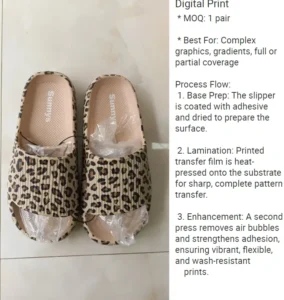
2.1 Digital Printing (MOQ: 1 Pair)
The Technology: High-definition inkjet systems that bond pigment directly to the EVA surface at a molecular level.
- Best For: Photo-realistic designs, complex gradients, and individual personalization.
- Advantage: Zero setup cost. You can literally order a single pair for influencer sampling or premium “Made-to-Order” collections.
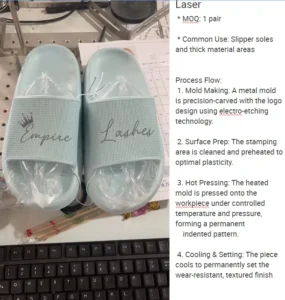
2.2 Laser Engraving / Carving (High Precision)
The Technology: A high-intensity CO2 laser vaporizes the surface of the EVA or PVC, creating a tone-on-tone recessed effect.
- Best For: High-end branding (like the “Vivenda SP” project), subtle textures, and industrial aesthetics.
- Advantage: It is permanent. Unlike ink, a laser-carved logo will never fade or peel, making it ideal for professional recovery slippers.
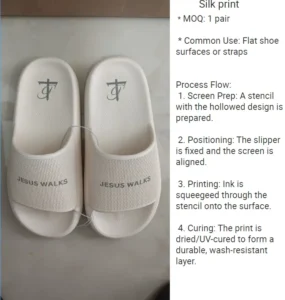
2.3 Silk Screen Printing (MOQ: 100 Pairs)
The Technology: A traditional but refined process where ink is pressed through a stencil.
- Best For: Solid block colors and high-contrast logos.
- Advantage: Extremely cost-effective at the 100-pair mark. We use high-elasticity inks that prevent cracking when the slipper flexes.
2.4 Heat Transfer Printing
The Technology: Pre-printed designs are transferred onto the slipper using heat and pressure.
- Best For: Multi-color patterns that require a “soft touch” finish.
- Advantage: Excellent durability and color vibrancy for summer-themed collections.
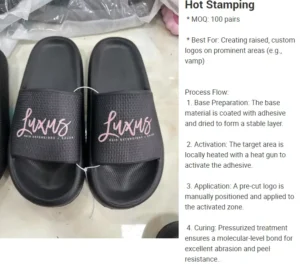
2.5 3D Floating Prints & Micro-Injection
The Technology: Injecting a liquid TPU or PVC layer onto the strap to create physical height.
- Best For: Premium streetwear brands and tactile logo experiences.
- Advantage: Creates a 3D depth that is impossible to achieve with flat printing, signaling “Luxury” to the end consumer.
Chapter 3: Material Science—The Backbone of Brand Loyalty
Customization is meaningless if the “canvas” fails. In Neikeng, our focus is on the biomechanics of Bio-Based EVA and High-Rebound PVC.
Material selection is only half of the comfort equation. For wellness-focused lines, building the outsole geometry around arch support slippers ensures your finished product delivers the orthopedic comfort premium buyers now expect.
3.1 EVA (Ethylene-Vinyl Acetate): The Gold Standard
For 2026, we have optimized our EVA formulas to meet two distinct needs:
- Soft-Cloud Recovery: Shore C hardness of 35C-38C. Ideal for post-workout recovery.
- Industrial Durability: Shore C hardness of 45C-52C. Best for high-traffic environments like hotels or outdoor usage.
3.2 Bio-Based Alternatives and ESG Compliance
Global brands are now mandated to report their carbon footprint. Our Bio-based EVA incorporates renewable resources (like sugarcane-derived ethanol), reducing the petroleum dependency by up to 30% without sacrificing rebound elasticity.
Chapter 4: The Economics of Mold Fees—The $1,500 Strategic Move
One of the biggest hurdles covered in any Low MOQ Slipper Customization Guide is the cost of private molds. We have simplified this with our B2B Growth Policy.
Before committing to private tooling, however, brands must lock in their size run. Cross-checking against an accurate slipper sizing chart early prevents expensive mold re-cuts and returns later.
4.1 Private Mold vs. Open Mold
- Open Molds: Use existing factory designs. Low cost, but no brand exclusivity.
- Private Molds: Unique designs that belong only to your brand.
- The $1,500 Policy: We charge $1,500 per size for private mold development. However, once your order volume reaches the agreed milestone, we refund the entire mold fee. This effectively makes your custom R&D cost-free in the long run.
Chapter 5: Why Neikeng, Jinjiang is the Global Epicenter
When you source from YC Footwear in Neikeng, you aren’t just buying a product; you are tapping into an Industrial Ecosystem.
5.1 Integrated Supply Chain
In Neikeng, every component—from the raw EVA granules and color pigments to the precision CNC mold cutters—is located within a 5-mile radius. This proximity is what allows us to offer Low MOQ while maintaining the speed and quality of a mass-production facility.
Chapter 6: Global Compliance and Certification
Navigating 2026 regulations is a minefield. Our products are engineered to pass:
- PFAS-Free (California AB 1817): We ensure our waterproof coatings contain no “forever chemicals.”
- REACH & CE: Full compliance for the European market.
- SATRA Technology: Independent footwear testing and certification that validates durability, safety, and material performance.
- BSCI & ISO 9001: Verification of ethical labor and consistent quality management.
Conclusion: Partnering for a Personalized Future
Mastering the art of customization covered in this Low MOQ Slipper Customization Guide is the fastest way to scale a footwear brand in the current market. Whether you are starting with 1 pair of digital prints or developing a full collection with $1,500 refundable private molds, your success depends on technical transparency and industrial reliability.
Ready to launch your custom collection? Contact YC Footwear today—where Neikeng’s precision meets your brand’s vision.