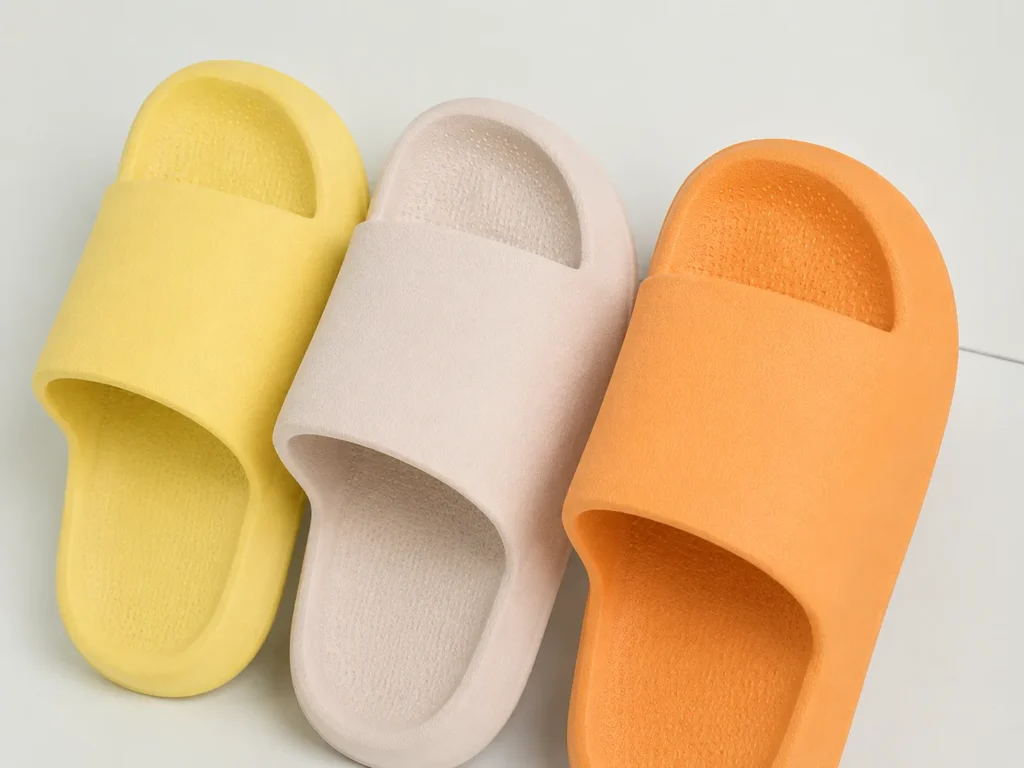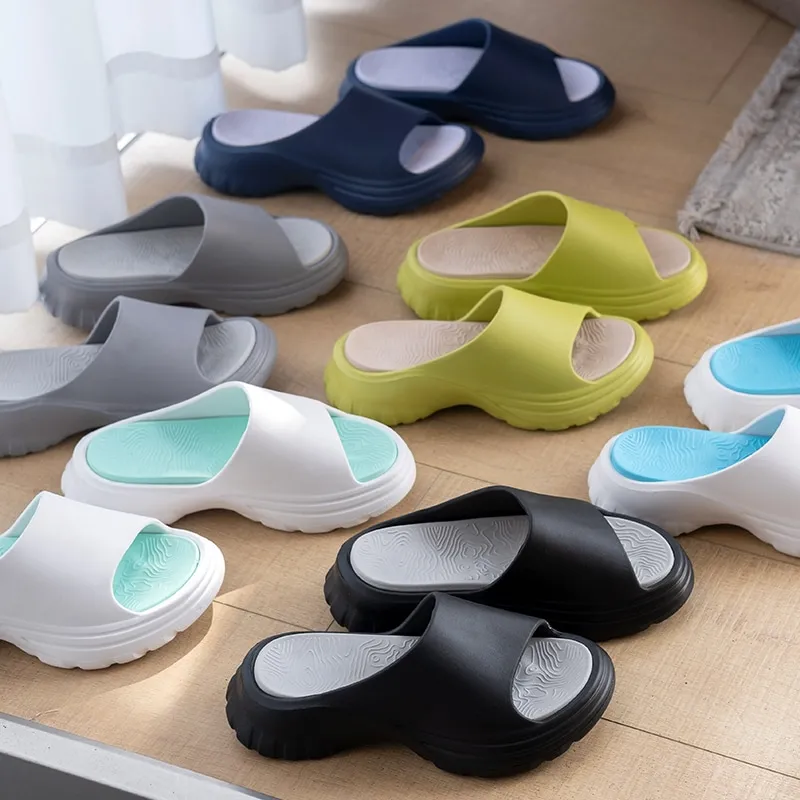
Slippers are worn more hours per day than almost any other footwear category, yet they are built to the tightest cost targets and replaced rather than repaired when they fail. For brands, importers, and distributors, that combination produces a recurring complaint category: pairs that feel excellent at delivery and come back as reviews about flattened footbeds, loose soles, cracked straps, or odor that washing cannot remove.
Slippers rarely fall apart because of one defect. They fail when several slow processes converge: foam that has taken a permanent compression set, polymer chains broken by moisture, adhesive bonds weakened by heat and solvent loss, and outsoles worn smooth by friction. The useful question for a wholesale buyer is not whether a slipper will wear out, but how many months of normal use it can absorb before the customer notices.
Understanding each failure mode, and the material and design decisions behind it, turns a vague durability claim into a purchasing specification.
Why Slippers Fall Apart: The Main Failure Modes
The dominant cause is compression set in the foam footbed, followed by hydrolysis in moisture-sensitive polymers, adhesive and bond failure, outsole abrasion, and heat or ultraviolet aging. In most returned pairs, at least two of these processes are already underway at the same time.
Durability problems are cumulative rather than sudden. A pair can survive heavy abrasion and still fail at month five because the footbed stopped rebounding, or sit perfectly in a warehouse and crumble on the first wear because the polymer aged in storage. Reading those clocks correctly is what lets a buyer write a usable specification with a Slippers Manufacturer instead of restating a material category on a quotation.
| Failure mode | Typical root cause | Usually noticed at | Buyer consequence |
| Compression set | Foam cells collapse under loading | 3 to 12 months | Complaints about hardness and lost cushioning |
| Hydrolysis | Moisture breaks polymer chains | 12 to 36 months, sometimes in storage | Crumbling soles, powder residue |
| Bond failure | Adhesive aging, contaminated surfaces | 6 to 18 months | Sole separation, straps pulling free |
| Abrasion | Soft compound, shallow tread | 6 to 18 months | Slipping risk, visual wear complaints |
| Heat and UV aging | Sun, hot vehicles, containers | Variable | Shrinkage, warping, color shift |
Compression Set: When the Footbed Never Springs Back
A cushioning footbed holds thousands of small gas pockets that compress under load and recover when the load is removed. Repeated loading overwhelms that mechanism: cell walls fatigue, adjacent cells collapse, and part of the original thickness never returns. That unrecovered fraction is compression set, and it is irreversible.
Economy-grade low-density foam can lose 20 to 40 percent of its original thickness within three to six months of daily wear, while mid-range and higher-density formulations last a year or longer. The two-second rule is a fast field check: press a thumb firmly into the footbed and release, and if it does not recover visibly within about two seconds the cushioning has failed. Because foam compresses unevenly, a spent footbed also tilts, which customers report as foot fatigue rather than as a material defect.
Hydrolysis: Why Unworn Slippers Still Crumble in Storage
Water is the least visible threat to footwear polymers. In moisture-sensitive formulations, hydrolysis occurs when water molecules attack vulnerable bonds in the polymer backbone and cut long chains into shorter fragments, costing the material its tensile and tear strength. The result is a midsole that turns soft, tacky, cracked, or powdery.
Storage accelerates the process rather than preventing it, because a stored pair is never flexed and absorbed moisture is never squeezed back out. Reaction rates roughly double for every ten degrees Celsius of additional heat, so an unworn pair in a humid container can show early hydrolysis within 18 to 24 months, while the same construction may last several years in cool, dry storage. Polyester-based polyurethane is more moisture-sensitive than polyether-based systems, but formulation, stabilizers, and process control all affect the finished part. For teams comparing Wholesale Slippers options, the practical question is whether a specific formulation has passed an aging requirement for the destination market.
Adhesive Failure, Abrasion, and Heat Aging
Adhesives age differently from the materials they join. Solvents and plasticizers migrate out of the bond line, peel strength falls, and the joint becomes vulnerable to shear, which is why bathroom products fail at the sole edge before the upper shows any wear.
Abrasion and heat work alongside it. Once tread in the high-pressure zones under heel and ball is polished smooth, grip and drainage are gone, and safety risk rises well before the product looks worn. Heat and ultraviolet light also deform foam, evaporate plasticizers, harden rubber, and shift pigments.
Material Durability Comparison for Wholesale Orders
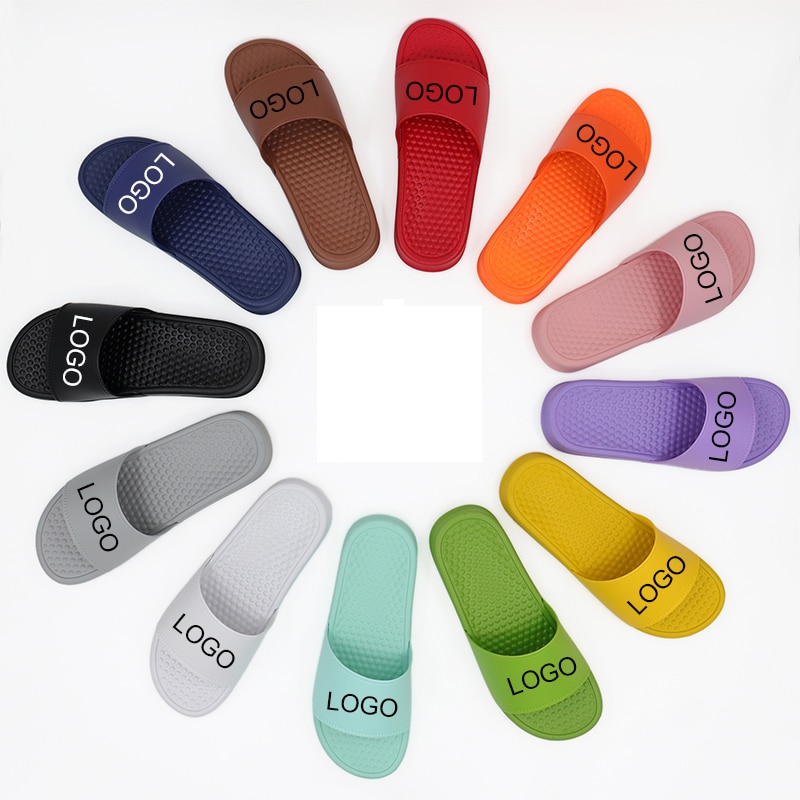
No single material wins on every axis. EVA offers the best balance of weight and cushioning but flattens fastest at low density; PVC resists abrasion and water well but is denser and less forgiving underfoot; TPR and rubber deliver the strongest rebound and grip at higher cost; polyurethane cushions best but carries the highest hydrolysis risk. Durability is a specification decision rather than a material preference.
| Material | Abrasion resistance | Resilience | Water resistance | Weight | Cost | Main risk |
| Low-density EVA | Low | Low to moderate | Good | Very light | Low | Rapid compression set |
| High-density EVA | Moderate | High | Good | Light | Moderate | UV and heat deformation |
| PVC | High | Moderate | Excellent | Heavy | Low | Hardening, low breathability |
| TPR | High | High | Good | Moderate | Moderate | Higher material cost |
| Rubber | Very high | High | Excellent | Heavy | High | Weight and stiffness |
| Polyurethane | Moderate | High | Moderate | Moderate | Moderate to high | Hydrolysis when humid |
Outsole, Footbed, and Upper Age at Different Rates
A slipper is three components with three separate lifespans: the outsole is governed by abrasion, the footbed by compression set, and the upper by flex fatigue and cleaning. Wholesale performance is decided by the shortest of those clocks, so upgrading a footbed while leaving shallow tread and a thin strap still produces early failure.
Density and Hardness: Why Softer Does Not Mean Stronger
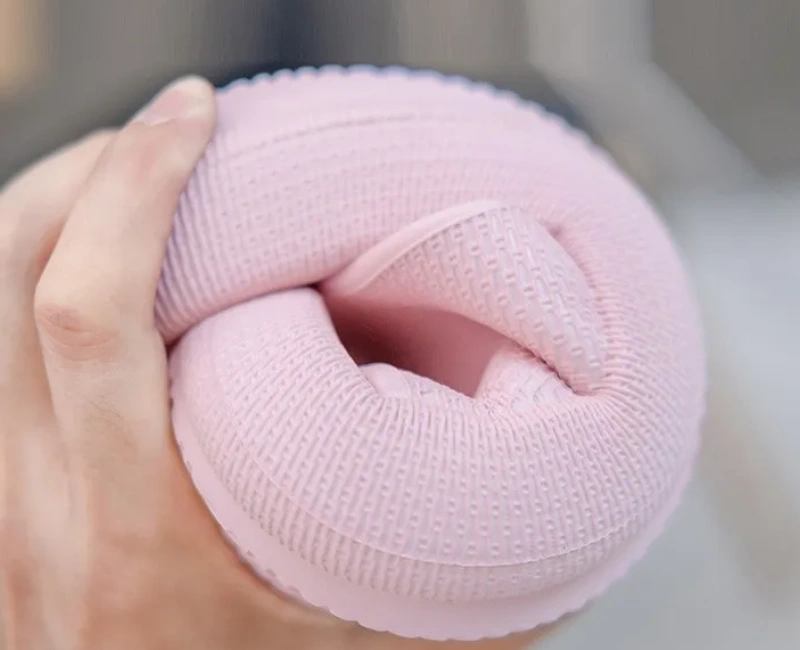
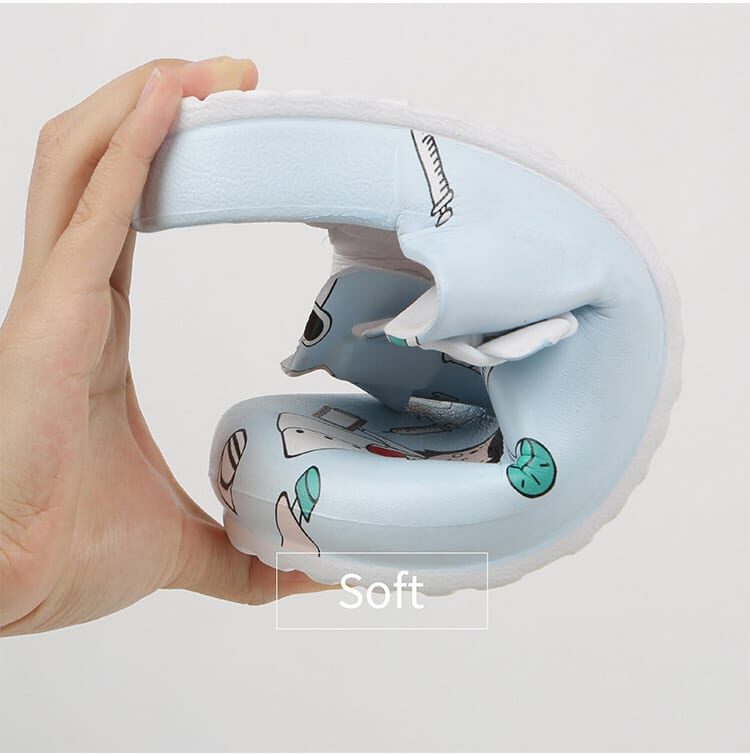
Vinyl acetate content and expansion ratio set foam density, and density sets how quickly the structure fatigues; very light foam feels generous on day one and compresses fastest because most of its volume is gas. Hardness follows the same logic, which is why footbed formulations sit inside a defined middle range and why layered construction works better, with a firmer base carrying the load and a softer top layer providing the initial feel. A slipper that folds in half without resistance is not a comfort feature but a signal that the footbed will not survive a season.
Design and Production Choices That Decide Slipper Life
Construction method, wall thickness, tread depth, and reinforcement at high-stress points decide durability as much as material choice does. A one-piece molded body removes the bond line responsible for most early failures, while a glued assembly depends entirely on bond preparation and process control.
One-Piece Molding vs Glued Assembly
Injection-molded one-piece slippers eliminate the adhesive joint between upper and sole, removing an entire failure mode at the cost of tooling budget and design freedom. Glued and stitched assemblies allow fabric, fur, and mixed-material uppers but introduce a bond line that must be controlled through surface preparation, adhesive selection, and cure conditions. Wet environments and heavy daily wear favor fewer joints, while fashion-oriented indoor products can accept a bond line if the supplier provides bond strength data.
Reinforcement Points, Tread Depth, and Wall Thickness
Failures cluster where stress concentrates: strap anchors, toe posts, the heel seat, the sole edge, and transitions between materials. Reinforcement at those points costs very little, and tread depth has a practical minimum below which grip and drainage are lost long before the product looks worn.
Foot Health Requirements: What Podiatrists Say Not to Wear
Podiatric organizations caution against slippers and sandals with no arch support, no heel stability, and no meaningful shock absorption, and against worn-out pairs whose cushioning has already collapsed. The American Podiatric Medical Association advises consumers to inspect older pairs and discard them when severe wear appears rather than wearing the same pair year after year.
That caution becomes a short design checklist: a stable heel seat, resistance to collapse under body weight, a sole that bends at the ball of the foot, and reliable grip on wet surfaces. Products that fail these checks drive the rapid wear-and-replace cycle that becomes negative reviews.
Storage, Shipping, and Shelf Life: The Buyer’s Blind Spot
The material clock starts when a slipper leaves the mold, not when a customer opens the box. Warm, humid storage and uncontrolled container transport can consume a meaningful share of a product’s useful life before it is ever sold, and that loss is invisible at delivery inspection.
| Risk factor | Why it matters | Practical control |
| High humidity | Supplies moisture for polymer breakdown | Dry storage, moisture-controlled packaging |
| Elevated temperature | Accelerates chemical aging | Avoid hot warehouses and roof-exposed containers |
| Long storage time | Extends cumulative exposure | First-in, first-out inventory and date coding |
| Stacking pressure | Deforms footbeds before sale | Control carton stacking height |
| Vulnerable formulations | Some chemistries absorb moisture faster | Request aging data for the destination climate |
Buyers shipping into hot, humid regions should treat shelf life as a specification item, with a stated maximum inventory age and a storage requirement passed through to distributors. A pair that performs well in a cool, dry market can behave very differentlyafter a month in a humid port warehouse, and the difference is usually blamed on the product rather than on logistics.
How to Verify Durability Before a Bulk Order
Ask for physical test data rather than relying on samples alone. Abrasion, flex, bond strength, compression set, and slip resistance results show how a construction behaves over hundreds of thousands of cycles, which no hand inspection of a brand-new pair can reveal.
| Property | Representative test method | What the result reveals |
| Outsole abrasion | SATRA TM174, DIN 53516, ISO 4649 | Volume loss under friction |
| Flex resistance | SATRA TM92, ISO 17707 | Cracking risk at flex zones |
| Sole bond strength | SATRA TM411, ISO 17708 | Whether the joint survives water and shear |
| Compression set | ASTM D395 | Footbed thickness permanently lost |
| Slip resistance | SATRA TM144, ISO 13287 | Wet and dry grip performance |
| Heat aging | ASTM D573 | Stability after high-temperature exposure |
Testing organizations such as SATRA maintain these methods, and an independent report removes the ambiguity of comparing marketing descriptions. Where a full program is impractical, request the two properties that correlate most strongly with returns in the target market: compression set for indoor products, and abrasion plus slip resistance for wet or outdoor use.
Field Tests You Can Run on a Sample Pair
- Press the footbed with a thumb and release; it should recover visibly within about two seconds.
- Bend the slipper end to end; it should flex at the ball of the foot and never fold in half.
- Twist the sole moderately; excessive flex indicates insufficient structural support.
- Submerge the pair for several hours, dry it, then check for bond-line separation.
- Load the footbed under body weight for an extended period and measure thickness recovery.
- Expose a sample to elevated temperature and compare dimensions against a control pair.
Quality Control Checkpoints Before Shipment
A durability specification only holds if the shipped batch matches the approved sample, which makes Slipper Quality Control the final gate before payment. Inspection should cover size grading, color consistency within and across cartons, bonding at the sole edge and every strap anchor, odor, and packaging that will not distort footbeds under stacking. Sample size and acceptance criteria belong in writing before production, not after the container is loaded.
The Three Shoe Rule and What It Teaches Buyers
The three shoe rule means rotating at least three pairs so that no single pair is worn two days in a row. Its real function is recovery time: cushioning materials need roughly a day or more to decompress and dry between uses, and rotation is one of the most effective ways to extend the functional life of a pair.
The rule is usually framed as foot health advice, but it is also a durability finding: compression set accumulates faster when a footbed is loaded before it has recovered, and trapped moisture cannot escape if the same pair is worn daily. For buyers the lesson is instructive rather than literal, because a pair worn all day, every day compresses roughly twice as fast as the same product used in rotation. That gap explains why identical goods produce very different complaint rates in different markets.
When Should Slippers Be Thrown Out?
Slippers should be retired when the footbed stops returning to shape, when the tread under the heel or ball is worn smooth, when the sole or strap shows separation, or when a persistent odor survives washing. Visible collapse is a late signal; most slippers stop doing their job several months before they look destroyed.
| Usage pattern | Low-density foam | Mid-range foam | High-density foam |
| Light use, 1 to 2 hours daily | 12 to 18 months | 24 to 36 months | 36 months and beyond |
| Moderate use, 4 to 6 hours daily | 4 to 8 months | 12 to 18 months | 18 to 24 months |
| Heavy use, 8 or more hours daily | 3 to 5 months | 6 to 12 months | 12 to 18 months |
The signals below are worth turning into a printed care card, because customers rarely replace indoor footwear on schedule.
- The footbed feels hard, flat, or harder at the heel than at the arch.
- Permanent indentations in the shape of the foot are visible.
- The slipper tilts to one side when placed on a flat surface.
- The tread pattern in high-pressure zones is smooth or polished.
- The sole edge, strap anchor, or toe post shows separation or fine cracking.
- A persistent odor returns shortly after cleaning.
Timelines also depend on use, since heat, repeated soaking, and prolonged sun shorten every interval above. More detail on expected lifespans and the warning signs that precede failure appears in this guide to How Long Do Slippers Last.
FAQ
Does a thicker sole always mean a longer-lasting slipper? Not necessarily. Thickness adds cushioning volume, but the rate of compression set depends on density and resilience, and an excessively thick sole can reduce stability instead of improving it.
Can slippers deteriorate while still in the warehouse? Yes. Constructions sensitive to moisture can begin to degrade during storage and transport, especially in warm, humid conditions, so cartons that look undamaged may contain footbeds that have already lost elasticity.
Is a heavier slipper a more durable one? Weight alone is not a reliable indicator. Density, rebound performance, bond quality, and tread design determine how long a pair lasts, and brittle compounds can crack at the sole edge despite their mass.