As we navigate the retail and wholesale landscapes of 2026, sourcing slippers from China has become more complex than simply browsing platforms like Alibaba or Made-in-China. To build a resilient supply chain and secure a competitive advantage, global footwear brands and retailers must look beyond superficial pricing. This strategic guide explores the five critical questions you must ask your Chinese slipper manufacturer before signing any contract, deep-diving into materials, silent supply chain killers, advanced crafting, low-risk tooling, and critical regulatory policies.
1. The “Silent Killers” of Sourcing: Quality Consistency and Lead Time Reliability
In B2B slipper sourcing, the most dangerous threats to your brand’s reputation are not initial price tags, but what we call the “Silent Killers”: quality consistency across mass production batches and lead time reliability. Many buyers receive a flawless initial golden sample, only to discover that the first mass-produced container features mismatched sizing, fading colors, or chemical odors.
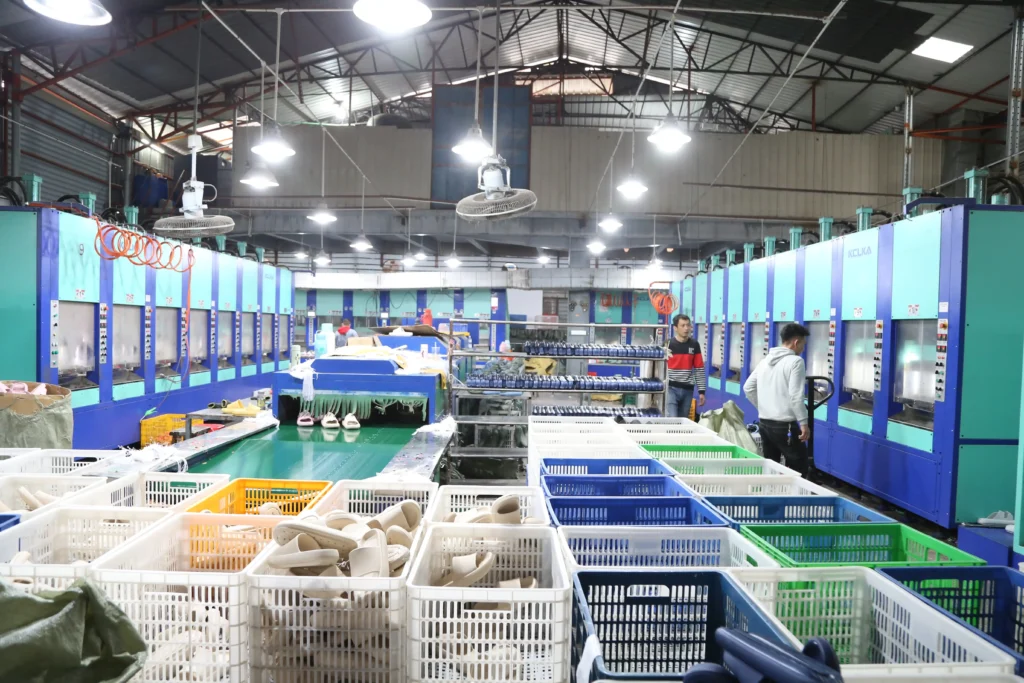
To avoid these silent killers, ask your manufacturer: “What specific quality control protocols do you implement to ensure batch-to-batch consistency, and how do you guarantee on-time shipping during peak seasons?” A professional manufacturer should provide a structured response detailing their raw material incoming quality control (IQC), in-process quality control (IPQC) at the foaming and molding stages, and final pre-shipment quality control (FQC) based on AQL 2.5/4.0 standards. Moreover, lead time reliability in 2026 relies on automated production planning and dedicated raw material reserves, protecting your brand from delayed product launches and costly stockouts.
2. Deep Dive into Material Science: Specifying Shore C Hardness and Compression Set
Slipper comfort and durability are heavily defined by material science, particularly when using Ethylene-Vinyl Acetate (EVA) foaming technology. Simply asking for “high-quality EVA” is a rookie mistake. In 2026, premium slipper brands specify exact engineering properties to ensure optimal performance.
First is **Shore C Hardness**. Depending on the slipper’s purpose, the density must be precisely calibrated. For cloud slippers and recovery slides, a Shore C hardness of 35° to 40° provides the signature ultra-soft, pillowy feel. For indoor-outdoor leisure slippers or supportive orthotic slides, a Shore C hardness of 45° to 50° is preferred to ensure structural integrity and prevent foot fatigue. Second is the **Compression Set** (rebound property), which measures the material’s ability to return to its original thickness after prolonged pressure. Premium EVA should exhibit a compression set of less than 35% under standard ASTM testing, guaranteeing that the slippers will not permanently flatten after just a few weeks of wear. Ask your manufacturer for their laboratory testing sheets verifying these exact material metrics.
3. Enhanced Craft Section: Leveraging Digital Printing and 3D Micro-Injection
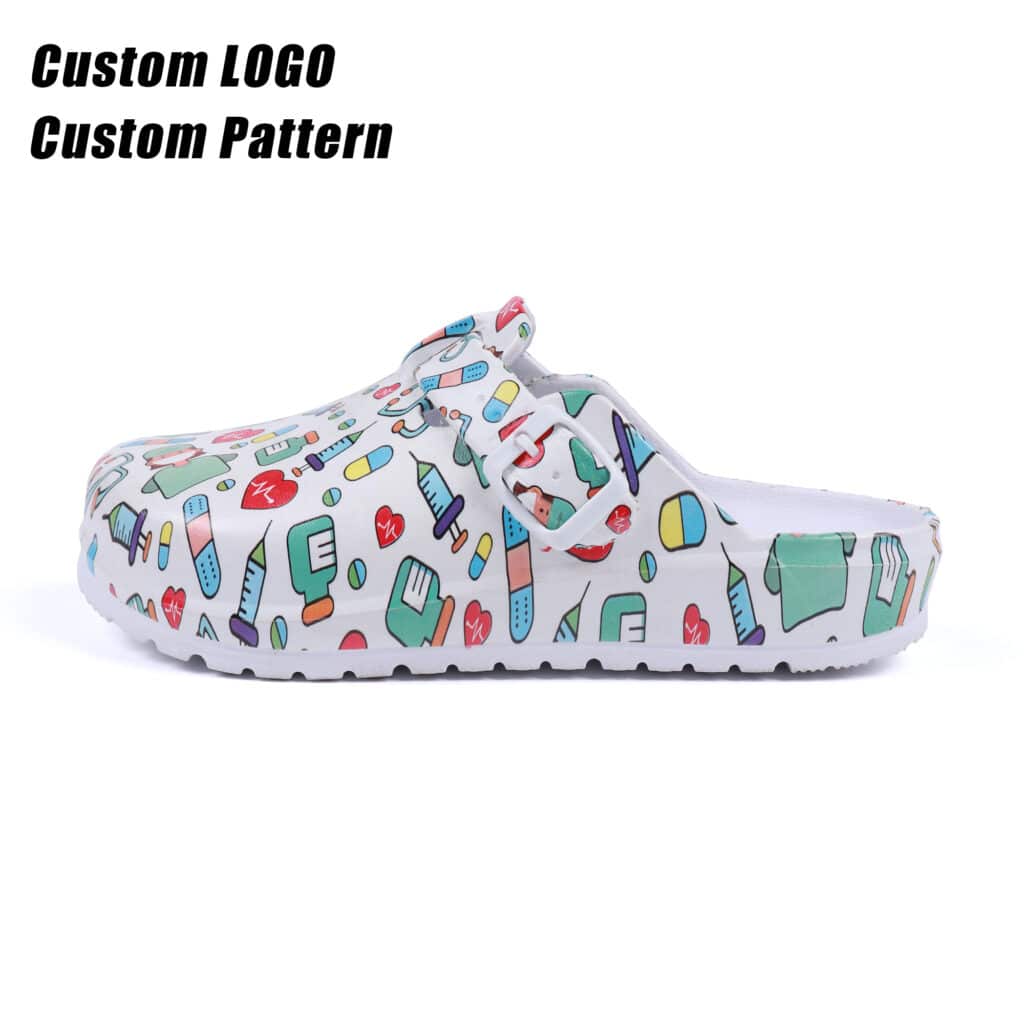
In a saturated retail market, visual appeal drives impulse purchases and social media virality. Traditional silk-screening and basic heat-transfers are no longer sufficient for complex, high-fidelity designs. Leading Chinese slipper manufacturers now offer cutting-edge decorative crafts that serve as powerful marketing engines: Digital Printing and 3D Micro-injection.
**Digital Printing** allows for full-color, high-resolution graphics to be printed directly onto the EVA surface. This technique eliminates the limitations of color screens, allowing for intricate gradients, photo-realistic patterns, and rapid customization. It boasts exceptional adhesion and UV resistance, meaning your vivid designs won’t crack or peel under direct sunlight or salt water. **3D Micro-injection** (PVC/Silicone rubber labeling) injects molten polymer directly into precision micro-molds, creating raised, multi-layered textures and logos with remarkable tactile depth. These advanced crafts elevate the perceived value of your footwear, justifying premium retail price points and significantly boosting brand loyalty.
4. Expanded Commercial Policy: Why a $1,500 Refundable Mold Fee is a Low-Risk Growth Engine
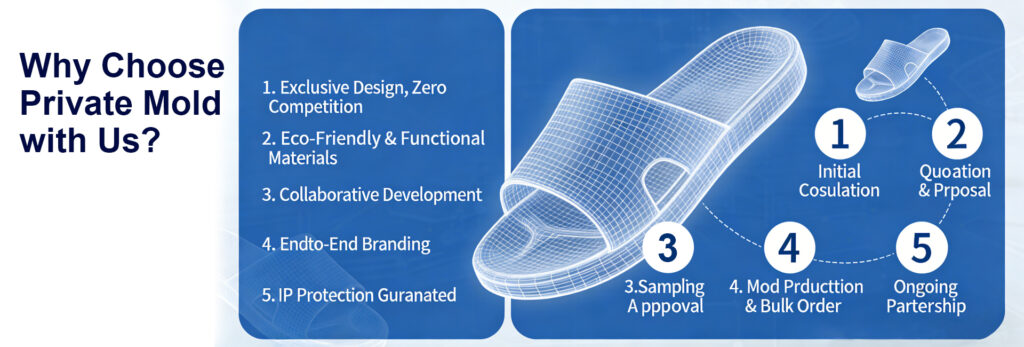
Tooling and mold costs are often a major financial barrier for small-to-medium retailers aiming to launch customized slipper designs. A single-size steel mold can range from $1,000 to $2,500. However, forward-thinking manufacturers in China are turning this cost into a mutual growth engine through flexible commercial policies, specifically a refundable mold fee of around $1,500 per size.
Under this policy, the brand pays an upfront deposit of $1,500 to cover the initial CNC tooling and sample creation. Crucially, this fee is fully refunded or credited against the balance payment once the mass production order reaches a pre-agreed milestone (e.g., 5,000 pairs across the size run). This low-risk financial structure aligns the interests of both parties. It allows retailers to test unique designs with minimal capital risk, while providing the manufacturer with a committed partner ready to scale production. It turns what was once a heavy capital expense into a highly accessible, low-risk growth engine.
5. B2B FAQ: Navigating Compliance and Logistics in 2026
To round out your sourcing strategy, here are the answers to key compliance, logistical, and operational questions that B2B buyers frequently face when manufacturing slippers in China.
Q1: Are your EVA and PVC slippers fully compliant with REACH and California Proposition 65 regulations?
Yes. Premium manufacturers utilize 100% virgin, non-toxic materials. We ensure our footwear undergoes strict testing by third-party laboratories (such as SGS or TÜV) to verify that phthalates, heavy metals, and volatile organic compounds (VOCs) are well below the strict thresholds defined by REACH in Europe and Proposition 65 in the United States. Compliance reports can be provided for every production batch.
Q2: How do you handle mixed-color and mixed-size logistics to optimize shipping container space?
We offer optimized sorting and packing solutions. Slippers are packed in custom polybags or shoeboxes, then consolidated into standard export master cartons. During loading, we utilize specialized container-loading software to mathematically plan the arrangement, ensuring mixed colors and sizes are grouped logically for easy warehousing upon arrival, while maximizing volumetric efficiency to lower your ocean freight cost per pair.
Q3: Can we adjust the Shore C hardness of the footbed and outsole separately in a dual-density slide?
Absolutely. Utilizing advanced dual-density co-injection molding machines, we can fuse an ultra-soft footbed (Shore C 35°-38°) with a highly durable, slip-resistant outsole (Shore C 50°-55°) in a single manufacturing cycle. This provides the ultimate combination of step-in plushness and long-lasting wear resistance.
Q4: What is the typical lead time for a completely custom mold design from CAD to mass production?
The process typically takes 40 to 50 days: 10-15 days for CAD design refinement and 3D-printed prototyping, 20 days for CNC steel tooling fabrication, and 15-20 days for initial trial molding, sample approval, and final mass production setup.