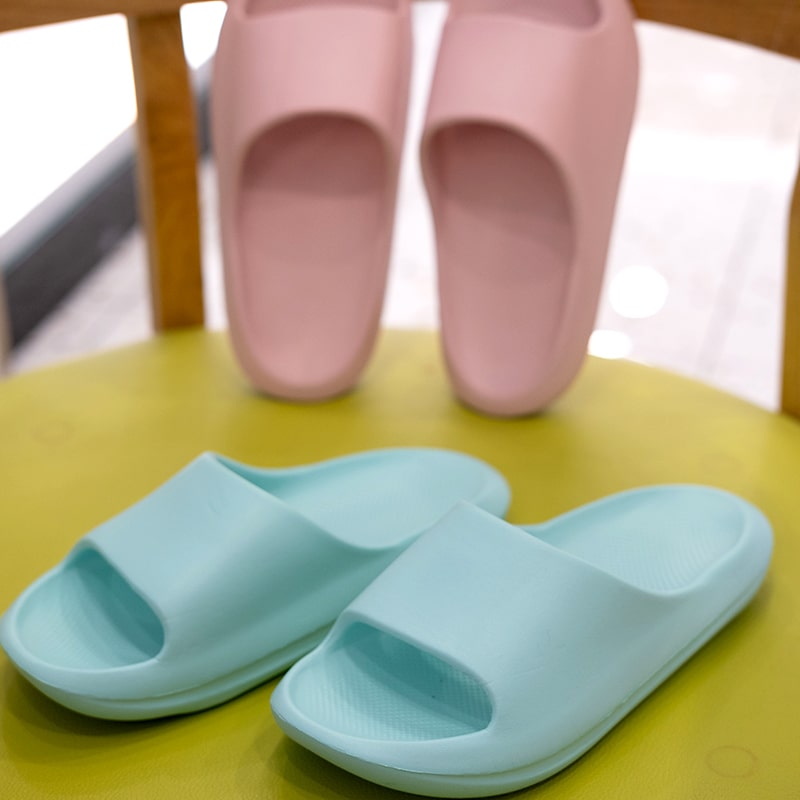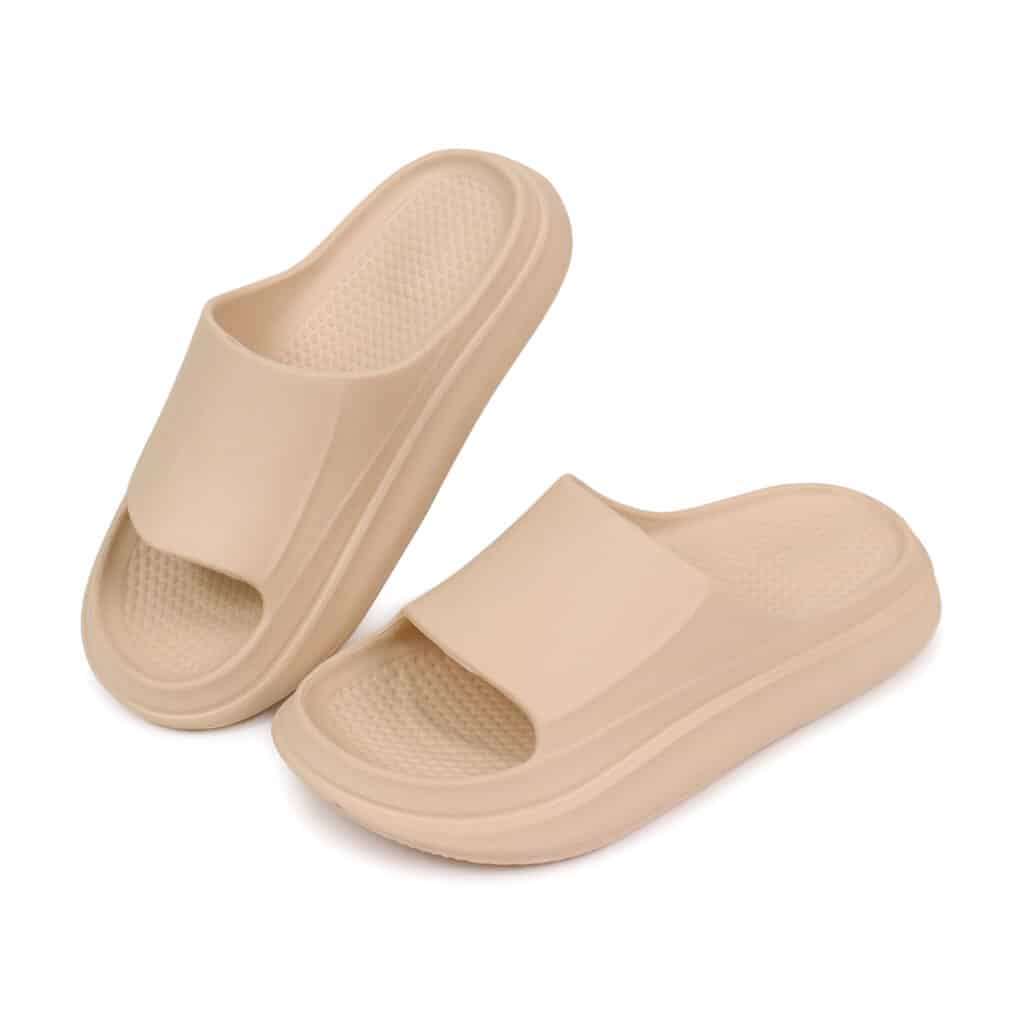
Bathhouses, saunas and public bath complexes have largely replaced single-use foam slippers with reusable pairs, moving the cost centre from procurement to reprocessing. A busy wet-area entrance hands out several hundred pairs a day, all exposed to standing water, bare feet, body heat and chlorine mist, and facilities that treat reusable slippers as footwear rather than as reprocessed equipment find out through odour complaints or a failed hygiene inspection.
Reusable slippers stay hygienic in a bathhouse when they are handled as reprocessed equipment rather than as shoes: sorted by material, scrubbed at a dedicated two-tank station, disinfected at a measured concentration for the full contact time stated on the label, dried completely in moving air, stored in a closed clean cabinet, and retired on a counted cycle threshold rather than on appearance.
The routine only holds when material choice, chemistry, drying and record keeping are designed together.
Why Do Reusable Slippers in Bathhouses Need a Different Routine?
A bathhouse exposes reusable slippers to conditions a home never reproduces: continuous standing water, dozens of different wearers a day, ambient heat above 30 C and airborne chlorine, so cleaning has to run as a scheduled production process rather than as occasional housework.
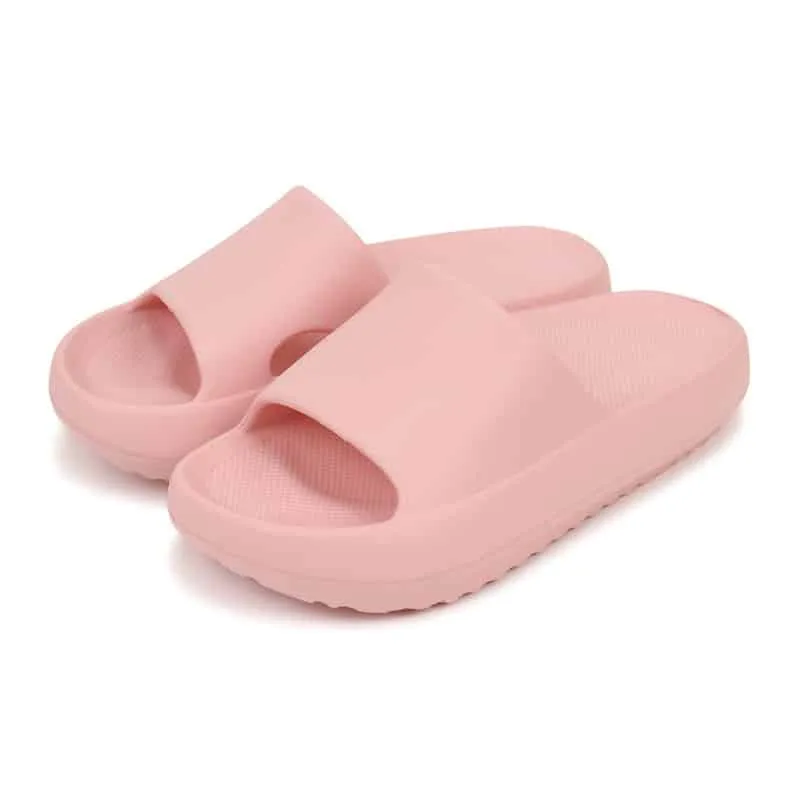
In a wet area the footbed rarely dries between guests. Sweat, sebum and shed skin are pressed into the textured surface with every step, and the warm film left behind is where bacteria and fungi multiply. Because contamination sits in the texture rather than on top of it, a rinse that looks adequate leaves residue that keeps feeding growth, and the smell returns within a shift, while a flattened tread leaves almost no grip margin on wet tile.
| Condition in a bathhouse | Effect on the pair | Operational response |
| Standing water at all times | Footbed stays damp, biofilm forms in texture | Forced-air drying after every cycle |
| 30 to 45 C ambient heat | Faster microbial growth, softened foam | Shorter reprocessing interval, cool storage |
| Tiled wet floors | Reduced grip margin, faster tread wear | Tread depth check at every sort |
| High daily turnover | Insufficient drying time per pair | Inventory sized to dry time, not guest count |
This comparison of Bathroom slippers against general indoor footwear covers the structural differences worth settling before anything is specified.
Which Materials Can Survive Repeated Washing and Disinfection?
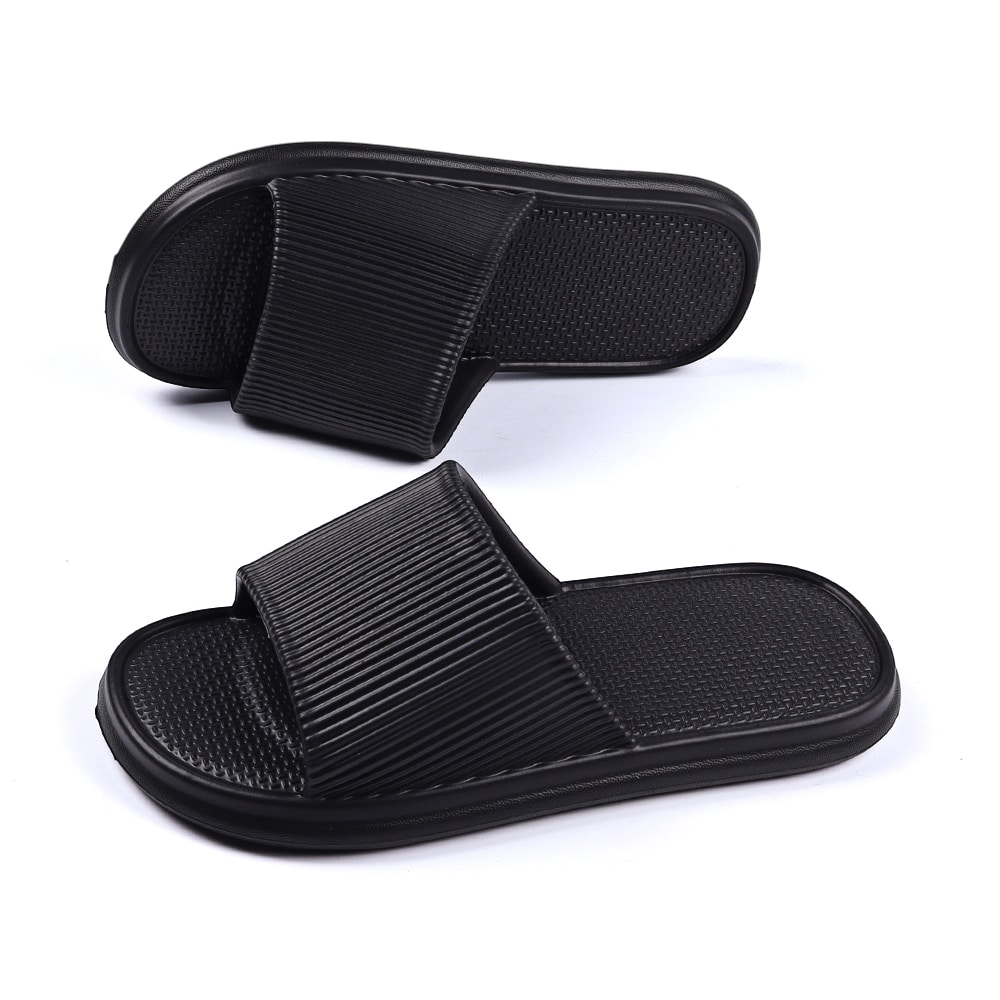
Only closed-cell, water-resistant materials survive a bathhouse loop, which in practice means EVA and dense PVC; open textiles, memory foam footbeds and brushed linings absorb water, dry slowly and fail long before the outsole wears through.
Cycle life is set by heat and chemical tolerance rather than by thickness or price. A pair that tolerates 60 C water can be processed thermally and skip the chemical step, while a pair that softens above 40 C limits the whole facility to low-temperature chemistry. Oxidising disinfectants also attack foam at the cell walls, hardening and chalking the surface over time.
| Material | Safe water temperature | Chlorine tolerance | Realistic cycles |
| Closed-cell EVA foam | Up to 40 C | Moderate, rinse fully | 30 to 60 |
| Dense PVC | Up to 50 C | Good, short contact | 40 to 80 |
| Vulcanised rubber | Up to 70 C | Good | 50 to 100 |
| Terry or textile upper | Up to 40 C | Poor, colour loss | 15 to 30 |
Closed-Cell Foam (EVA) as the Default for Wet Areas
EVA has no open pores, so water and detergent cannot wick into the body of the sole, and one-piece moulding removes the seam between footbed and outsole where contamination normally collects. The trade-off is thermal sensitivity: above roughly 40 C the foam softens and takes a permanent set under load, and direct sunlight degrades the surface within weeks.
PVC, Rubber, and Textile Uppers: Where They Fit
PVC and rubber tolerate hotter water and stronger chemistry, which suits facilities that already run a thermal step for other linen; they are heavier and louder on tile. Textile and terry uppers belong in dry zones, since in a wet area they hold water for hours and their adhesive bonds fail after a limited number of soak cycles. Sourcing both categories from one Slippers Manufacturer keeps the material specification and reprocessing instructions consistent across a property.
How Do You Build a Daily Clean-and-Disinfect Workflow?
Build the reusable slippers workflow as a fixed seven-step sequence with a physical boundary between dirty and clean, staffed so that no pair can skip a step: collect and sort, pre-clean, prepare the solution, soak for the full contact time, rinse, dry, and store in a marked clean cabinet.
- Collect used reusable slippers in closed containers and move them away from guest areas without passing through clean storage.
- Sort by material and size, and pull any pair that fails the tread or delamination check.
- Pre-clean in a decontamination tank with neutral detergent at pH 6 to 8 and a soft brush, working the footbed texture and strap joints.
- Prepare disinfectant with a dosing measure, never by eye, and verify concentration with a test strip.
- Immerse fully, weighing pairs down so no air pocket forms, and hold for the contact time printed on the label.
- Rinse in a separate clean-water tank until residual disinfectant is gone, then drain and rack.
- Log the batch in the drying room before the pairs re-enter inventory.
| Parameter | Chemical disinfection | Thermal disinfection |
| Active condition | 250 to 500 mg/L available chlorine | 100 C steam or boiling water |
| Contact time | 30 minutes minimum | 20 to 30 minutes |
| Material limits | EVA, PVC, rubber | PVC and rubber only |
| Main risk | Residual chlorine, odour, colour loss | Warping and shrinkage of foam |
Either route must follow the registered label exactly, and EPA registered disinfectant listings confirm that a claim and a contact time exist for the formulation in use.
Two-Tank Setup and Cross-Contamination Controls
A workable station needs two tanks or deep sinks plus one covered disinfection bucket, each with its own tools. Colour-code tanks and racks, and never top up a bucket with fresh pairs mid-cycle: unsoaked additions dilute the active concentration and give the whole batch a false contact time. Training starts from the basics of How to Wash Slippers before station layout is introduced.
How Do You Sanitize Slippers So the Result Is Verifiable?
Sanitising becomes verifiable when every batch has a measured concentration, a logged contact time, a documented rinse and a periodic ATP or culture check, because the process rather than the appearance of the pair is what an inspector can review.
Cleaning, disinfecting and sterilising are three different levels of reduction, and a laundry routine borrowed from bed linen does not automatically reach the level reusable slippers need. The mechanism operators most often get wrong is contact time: doubling the concentration does not shorten the soak, and in fact raises residue and material damage without improving the kill rate.
| Verification method | What it proves | Suggested frequency |
| Visual inspection under good light | Soil and residue removal only | Every batch |
| Test strip on prepared solution | Concentration was right at mixing | Every batch |
| ATP swab on footbed | Organic residue remains after cleaning | Weekly |
| Surface swab culture | Microbial reduction was achieved | Monthly, or after any process change |
Keep the batch record to five fields a supervisor can check in seconds: date and batch number, measured concentration, soak start and end, drying completion, and operator initials. Records that take longer stop being completed within a month, a principle that clinical guidance on disinfection and sterilisation applies as risk-matched processing levels.
How Do You Deodorize Slippers Between Guests?
Odour comes from bacteria breaking down sweat and skin residue trapped in the footbed texture, so deodorising only works on a completely dry pair; a fragrance sprayed onto a damp footbed masks the smell for an hour and feeds the next generation of growth.
The practical order is dry first, adsorb second, neutralise third. A light dusting of bicarbonate of soda left for several hours and then brushed out pulls residual moisture and odour compounds from the texture, and a dilute white vinegar wipe neutralises the alkaline detergent residue that keeps attracting moisture. UV cabinets work as a holding step in a clean store but cannot replace the wash cycle, since ultraviolet light only reaches surfaces it can see. Errors that shorten useful life:
- Sealing damp reusable slippers into a storage bag, which produces mildew within 48 hours.
- Using chlorine bleach as a deodoriser on foam, which attacks the cell walls.
How Should Slippers Be Dried and Stored to Prevent Recontamination?
Drying decides whether the rest of the process counts: a disinfected pair that stays damp for six hours in a closed cabinet is recontaminated before it reaches a guest, so drying capacity rather than washing capacity is usually the real bottleneck.
Air movement matters more than heat for foam footwear, and gentle warmth below 35 C speeds it without softening the compound. A workable drying room holds reusable slippers on open wire racks with a hand width between them, faces the openings downward so water drains instead of pooling, and keeps relative humidity under 60 percent with continuous extraction. Sunlight and radiator tops are both counterproductive: ultraviolet light chalks EVA and uneven heat warps the sole.
- Allow 6 to 12 hours of forced-air drying depending on wall thickness and ambient humidity.
- Store finished pairs in a closed, labelled cabinet, never on open corridor shelving.
- Cap batch size at what the drying room can clear in one shift.
When Should a Pair Be Retired?
Retire a pair when a counted cycle limit or a measurable wear threshold is reached, whichever comes first, because the visual judgement that a pair still looks acceptable is exactly the judgement that fails in a wet area under poor light.
Two independent limits keep the decision objective: a hard cycle count no pair exceeds, and physical indicators checked at every sort.
| Indicator | Threshold | Action |
| Tread depth | Below 1 mm at heel or ball | Withdraw, slip risk |
| Compression set | Footbed stays indented after flexing | Withdraw, cushioning gone |
| Residual odour | Present after a full cycle | Withdraw, foam saturated |
| Delamination or cracking | Any visible separation | Withdraw, harbour point |
| Surface chalking | Widespread on the footbed | Review chemistry and drying |
Cycle Counting and Replacement Intervals
Attach a batch code to each purchase lot and increment a counter every time it passes through the station, which is one extra line on the existing disinfection record. Set the hard limit below the material’s tested cycle life, and hold 10 to 15 percent of inventory as rotating spare capacity. Tread wear is not cosmetic: ASTM F2913 measures friction coefficient on the same principle that a polished outsole loses grip on wet tile.
How Do You Control Loss, Guest Take-Home, and Cost per Cycle?
Reusable slippers are a consumable asset in a wet-area business, so the purchase decision belongs to a cost-per-use calculation that includes reprocessing labour and attrition rather than to a comparison of unit prices.
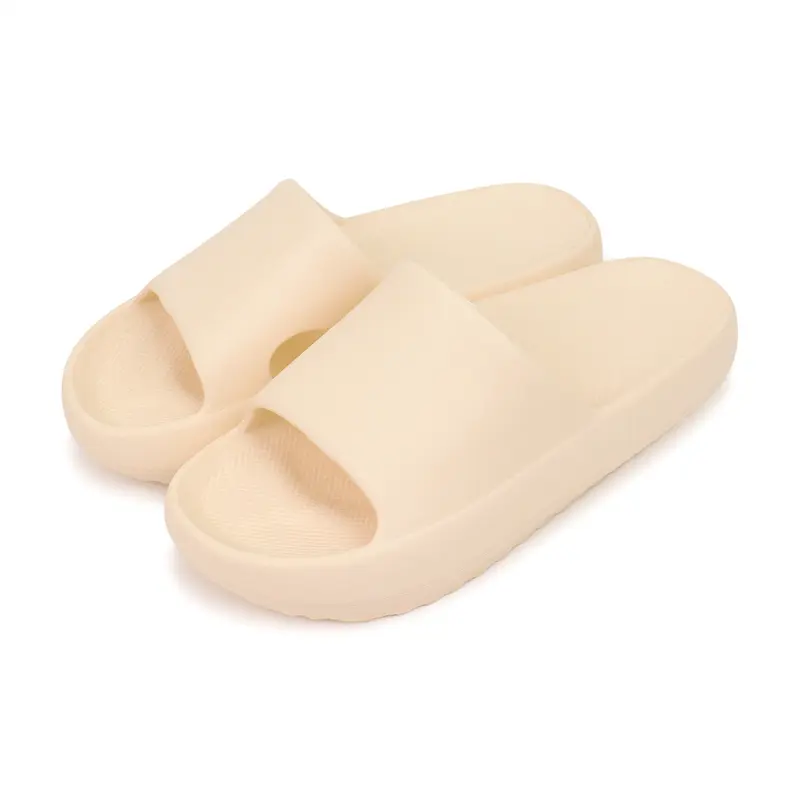
The arithmetic is simple: purchase price plus the direct cost of one reprocessing cycle, divided by the cycles actually achieved, which is always lower than the number claimed.
| Cost line | Basis to record |
| Purchase price per pair | Landed cost including freight and duty |
| Reprocessing cost per cycle | Labour minutes plus water, chemistry, power |
| Achieved cycles | Withdrawal log divided by lot size |
| Attrition rate | Pairs lost per 1,000 issues |
Is It Okay for Guests to Take Slippers Home?
The answer depends on how the pair is classified. A single-use pair is a consumable and can be offered as a take-home item with no hygiene claim attached. Reusable slippers that have been through a disinfection loop are facility equipment: letting it leave with a guest transfers an unverified item into a private setting, removes it from the batch record and quietly raises the attrition line. Where management wants the goodwill, the cleaner option is a sealed new pair presented at checkout from the Wholesale Spa Slippers range, with reusable stock marked as property.
FAQ
Three questions come up once the operating routine is settled, and each one sits outside the daily sequence rather than inside it.
How should a pair be handled after a guest with a diagnosed foot fungal infection? Treat it as a separate stream rather than a stronger wash. Bag the pair, process it alone or at the end of a batch, use fresh solution at a verified concentration, and record the event. Where the material is near its cycle limit, withdraw it instead of reprocessing, since compromised foam holds moisture no chemistry can reach.
Can reusable slippers be processed in the same batch as towels and robes? They can share a room but not a load. Textiles release lint that lodges in footbed texture, and drum action deforms foam soles. Keep separate tanks, racks and drying positions.
What is the minimum viable protocol for a small facility without a dedicated laundry room? Two deep sinks, one covered bucket, a dosing measure, test strips and a forced-air rack cover the essentials. Run one batch per shift at a fixed time, hold the full contact time, dry overnight in a closed room with a fan, and log the five fields. Size purchase volume to what the rack can clear in one night.