Slippers are one of the most frequently reordered items in the footwear trade. Hotels replace guest slippers in bulk, retailers restock best-selling house shoes every season, and promotional buyers reorder the same custom design year after year. The business model only works when a size 9 in this month’s shipment fits the same as a size 9 from last season, and it is the first thing most buyers probe when they evaluate a slippers manufacturer. In practice, many buyers discover too late that the second or third batch runs tighter, shorter, or roomier than the approved sample, which triggers returns, re-labeling costs, and disputes over who pays for the mismatch. The problem is rarely careless manufacturing. It is the natural result of many small variables drifting between production runs when no formal system holds them in place.
Keeping slipper sizing consistent across production batches comes down to controlling five things: a sealed master sample that every batch must match, a documented size chart with explicit tolerances, calibrated lasts and molds that are maintained and replaced on schedule, locked-down material specifications and stable workshop conditions, and staged measurement checks from first-article inspection through AQL-based pre-shipment inspection. When all five controls run together, batch-to-batch variation stays inside a tolerance window measured in millimeters instead of half sizes.
The sections below walk through where sizing variation actually enters the slipper making process, and the specific controls that keep every batch measuring the same as the approved sample.
Why Slipper Sizing Drifts Between Production Batches
Slipper sizing drifts between batches because four variables quietly change over time even when the design stays identical: lasts and molds wear down with use, raw material lots differ in density, thickness, and stretch, workshop temperature and humidity affect forming and bonding dimensions, and different operators or shifts introduce small differences in cutting tension and stitching. Each factor alone moves dimensions by a millimeter or two, but together they can shift a size mark by a full half size between two deliveries.
Understanding the sources is the first step to controlling them. Factories that measure and record these variables can predict and prevent drift instead of reacting to it after a customer complains.
| Source of Variation | How It Affects Sizing | Typical Warning Signs |
| Last or mold wear | Repeated pressing and molding gradually erodes edges and cavities, shortening the finished length or narrowing the toe box | Later batches measure shorter than the sealed sample with no material change |
| Material lot differences | Foam density, fabric shrinkage, and rubber hardness vary between supplier lots, changing how the upper stretches and how the sole holds its shape | Fit feedback changes after a new material shipment arrives |
| Workshop environment | Temperature and humidity swings alter EVA expansion, adhesive open time, and fabric relaxation during lasting | Summer and winter batches of the same style fit differently |
| Operator and shift differences | Hand positioning during cutting, stitching tension, and lasting pressure vary between workers and lines | Defects cluster on specific lines or shifts rather than across the whole order |
The commercial impact is what makes this a boardroom issue rather than a technical footnote. A batch that runs small forces markdowns or size re-labeling. A batch that runs large produces heel slippage, blisters, and returns that land on the distributor, not the factory. For buyers placing repeat orders, inconsistent sizing also poisons replenishment planning, because a size curve tuned to one batch no longer matches the next one.
The Slipper Making Process and Where Sizing Variation Enters
Sizing consistency has to be engineered into the slipper manufacturing process itself, because every stage of production can add or subtract millimeters. The process runs from design and pattern making, through material preparation, cutting or molding, upper assembly, lasting and sole bonding, finishing, and final inspection, and each handoff between stages is a point where dimensions can drift if no checkpoint catches it.
Slipper production follows two main routes, and they fail in different ways.
Molded Slippers: Injection and Compression Molding
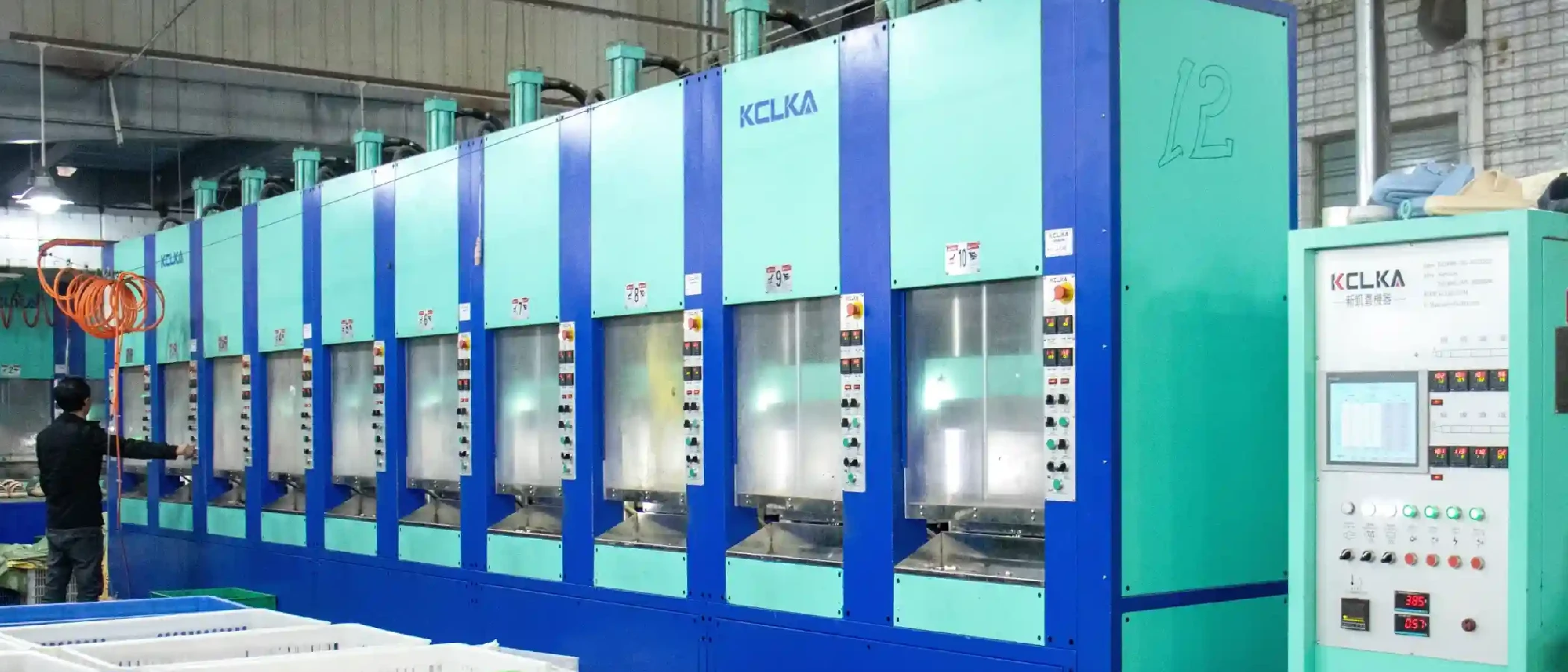
Molded slippers are formed from thermoplastic compounds, most commonly EVA and PVC. In injection molding, the heated compound is forced into a closed steel mold and cools into its final shape. In compression molding, a pre-weighed material block is pressed in a heated mold, giving better control over density and thickness at a slower cycle.
For sizing, three variables matter most. First, the mold cavity itself defines the length, width, and arch profile, so mold wear directly becomes size drift. Second, the compound’s shrinkage rate depends on its formulation and on how consistently it is mixed and heated, which is why material lot control and injection parameter logging matter as much as the tooling. Third, cooling time affects how much the finished part contracts after it leaves the mold, so rushing the cycle to hit output targets quietly shortens the product.
Cut-and-Sew Fabric Slippers
Fabric slippers follow a different flow: patterns are laid on rolls of material and cut by hand or computerized cutter, sewers assemble the upper and lining, and the finished upper is bonded or stitched to a pre-made sole.
Here the sizing risks are cutting accuracy, seam allowance discipline, and fabric stretch. Knit and fleece fabrics relax after cutting, and if the cutting table’s tension or direction changes between batches, identical patterns yield different finished lengths. Stitching tension pulls seams tighter or looser, and inconsistent adhesive application on the sole bond changes how much the upper compresses when attached.
Key Sizing Checkpoints in Each Stage
A disciplined factory maps the process into checkpoints, each with a measurable output:
- Pattern and grading check: verify the graded size run matches the approved measurement chart before any material is cut.
- Incoming material inspection: test fabric stretch percentage and foam density against the locked specification sheet.
- First-article inspection: measure the first completed pairs of each size against the sealed master sample before the line runs at full speed.
- In-line measurement audit: pull a fixed number of pairs per hour and measure insole length, ball width, and heel height.
- Lasting and bonding check: confirm upper placement is symmetrical and the bond line sits in the same position as the master.
- Final size-run verification: measure every size in the order, not just the middle sizes, and confirm labels match the measured dimensions.
Establish a Master Size Standard Before Production
The single most effective control for batch-to-batch consistency is a sealed master sample combined with a documented size chart that states, for every size, the target measurement and the tolerance the factory is allowed to work within. A sealed sample converts a subjective judgment into an objective comparison, and a tolerance chart tells both sides exactly when a batch passes and when it fails.

Approved Master Samples and Last Calibration
A master sample is a physically approved pair, signed off and sealed by the buyer, that stays at the factory as the reference for every future order. Each production batch should be compared against it directly, not against memory or a photo.
The master sample is only as good as the last or mold that produced it. Lasts should be calibrated against a reference gauge when new, checked on a regular schedule during use, and replaced once wear pushes dimensions outside tolerance. Factories that track last condition by serial number can trace a size drift back to a specific tool instead of guessing.
Size Charts and Tolerance Levels
A usable size chart specifies more than a label. It converts each size into physical measurements, because international size systems such as US, UK, and EU markings do not translate one-to-one, as an overview of shoe size systems makes clear. A chart built on millimeters removes that ambiguity, which is why experienced buyers treat the wholesale slipper sizes chart as part of the purchase order rather than as marketing copy.
| Measurement | Reference Point | Typical Tolerance |
| Insole length | Heel end to toe end along the centerline | plus or minus 2 to 3 mm |
| Outsole length | Heel to toe of the finished sole | plus or minus 2 to 3 mm |
| Ball width | Widest point across the forefoot | plus or minus 1.5 to 2 mm |
| Heel height | Base to top of heel cup | plus or minus 2 mm |
| Strap length | Fixed end to adjustment midpoint | plus or minus 3 mm |
| Opening girth | Across the instep of the finished upper | plus or minus 4 mm |
Tolerances should be written into the purchase order, not negotiated after the goods are made. A factory that knows the pass line can manage to it; a factory that guesses will optimize for output instead.
Control Materials, Lasts, and Production Conditions
Sizing consistency is preserved, not created, on the production floor. It is preserved by holding three things constant between batches: the materials, the tooling, and the environment. A change in any of the three shows up first as a change in dimensions, which is why all three need written specifications and scheduled verification.
Material Batch Management
Every material in a slipper influences fit. Upper fabrics determine stretch and relaxation, foams determine compression underfoot, and sole compounds determine how the base holds its shape. Consistency improves when factories order enough of one lot to cover a full production run, test each incoming lot for stretch percentage, density, and thickness against the locked specification, and record lot numbers per batch so that any future drift can be traced to a specific material shipment.
When a lot must change mid-program, the correct response is a mini trial run and a first-article measurement against the master sample, not a silent substitution.
Last and Mold Maintenance
Lasts and molds are consumables, not permanent assets. A compression mold that has run hundreds of thousands of cycles will not produce the same dimensions it did when new. Factories should maintain a registry of each tool’s usage count, inspect high-contact areas on a schedule, recut or recalibrate tools that drift, and retire them before they push product out of tolerance. For buyers, asking how a factory tracks tooling life is a quick credibility test.
Temperature and Humidity Control
Thermoplastics expand and contract with heat, adhesives change behavior with humidity, and fabric relaxes differently in dry and damp air. A molding workshop that runs hot in summer and cold in winter can produce measurably different slippers from the same mold and compound. Stabilizing the workshop environment, or at minimum logging conditions per batch so variation can be explained, closes this gap.
In-Process and Final Size Inspection
Inspection keeps sizing consistent by catching drift while it is still correctable, which means measurement must happen during production, not only after it. An effective program combines fixed-frequency inline measurement audits with a statistical pre-shipment inspection built on AQL sampling, so pass and fail decisions are objective numbers rather than opinions.
Inline Measurement Checks During Production
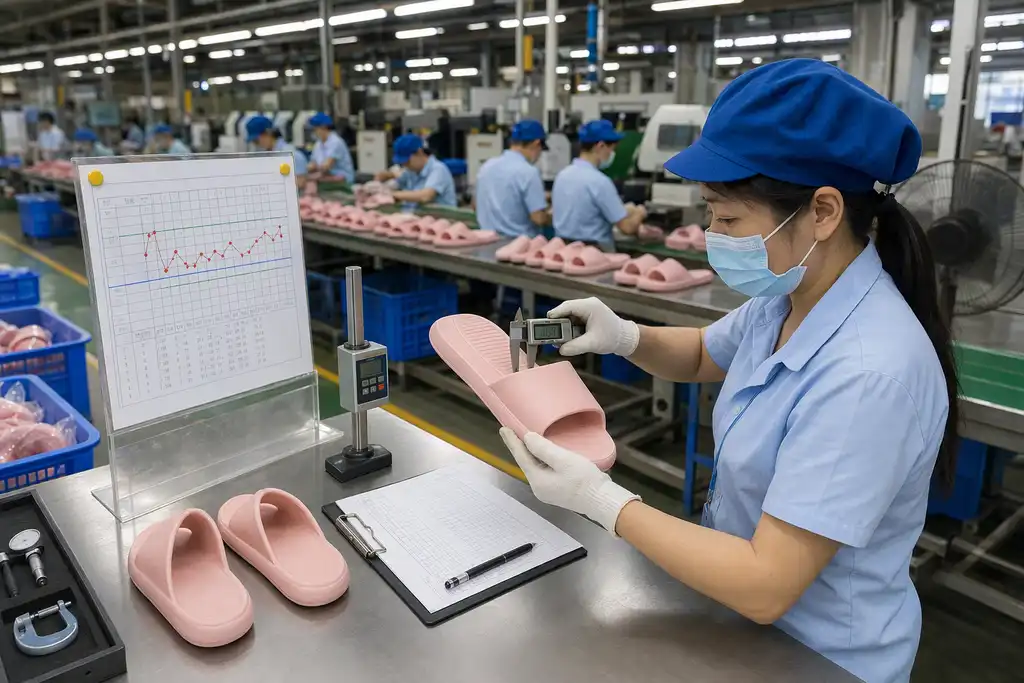
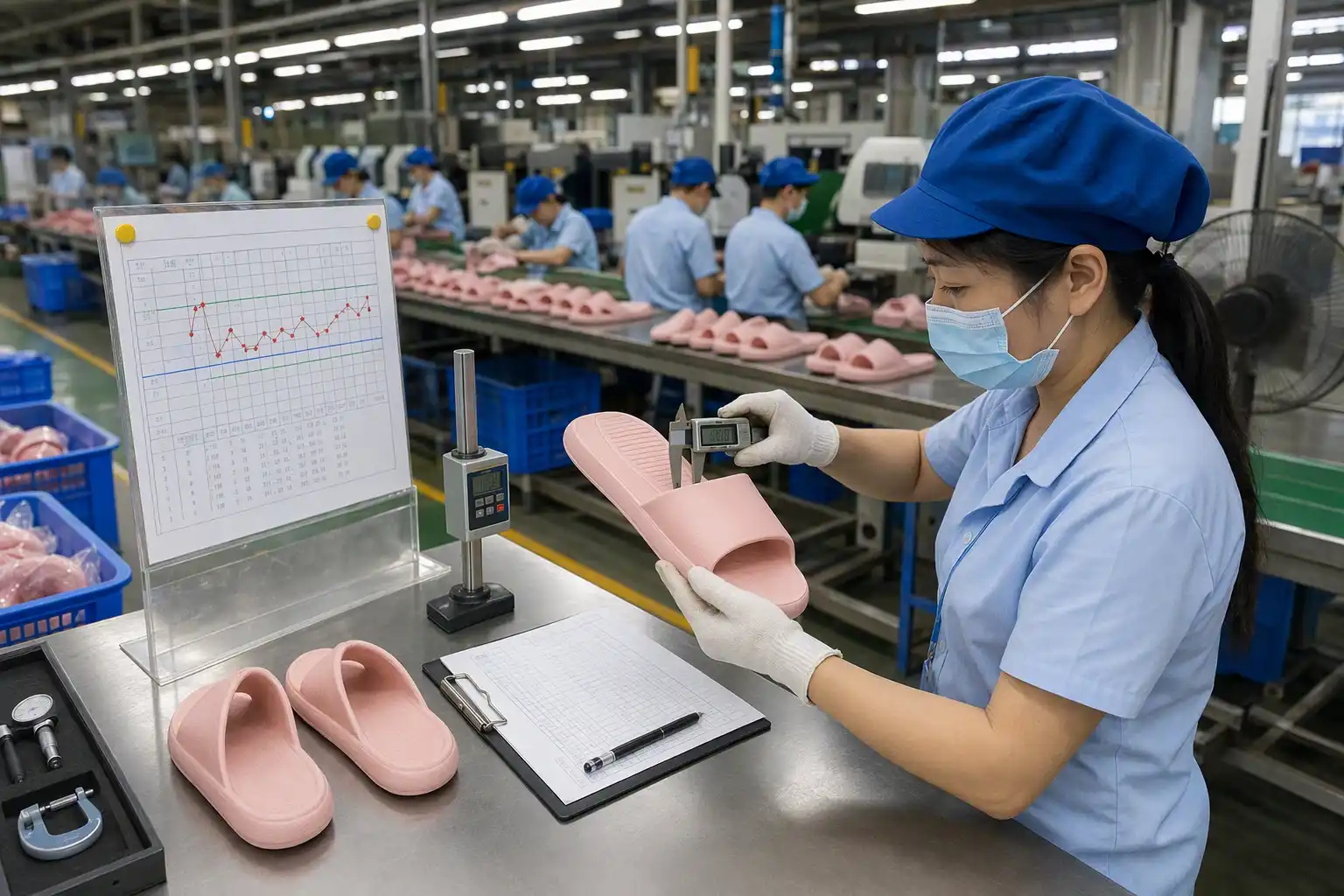
During production, quality staff should pull a fixed sample of pairs from each line at set intervals, for example every two hours, and measure the critical dimensions from the size chart: insole length, ball width, and heel height. Results go onto a simple run chart. The value of the run chart is that it shows a trend before it shows a failure, so a slow drift toward the tolerance edge triggers a tool check while the line is still making good product. Structuring these checks inside a documented quality management system aligned with ISO 9001 requirements makes the records auditable and repeatable across seasons.
AQL Sampling and Pre-Shipment Inspection
At the end of production, the final layer of slipper quality control applies statistical sampling to the finished order. The widely used approach in footwear is AQL, the Acceptable Quality Limit, which defines how many pairs to inspect and how many defects are acceptable before the lot fails.
| Defect Class | Typical AQL Level | Sizing-Related Examples |
| Critical | 0 | Wrong size label on a full size run, safety hazard |
| Major | 2.5 | Measured length or width outside tolerance |
| Minor | 4.0 | Cosmetic asymmetry within tolerance |
For sizing specifically, the pre-shipment inspection should measure a sample of every size in the order, verify that printed size labels match actual measurements, and confirm the size-run assortment matches the packing list. Independent testing bodies such as SATRA publish footwear test methods and measurement guidance that both buyers and factories can reference when agreeing on what to measure and how.
Batch Records and Continuous Improvement
The last layer of consistency is data. Factories that record measurements, material lots, tool usage, and inspection results for every batch can compare batches over time, spot a drifting tool or supplier before the next order ships, and prove to buyers that the size that fit last year is the same size arriving this year.
A practical batch record contains four items: the measurement results of the sample pulled at start, middle, and end of production; the material lot numbers used; the last or mold serial numbers and their usage counts; and the AQL inspection report. When a buyer reports that a new batch fits differently, this record turns a week-long argument into a ten-minute diagnosis.
The feedback loop matters as much as the records. Fit complaints, return rates by size, and wearer feedback should flow back to the factory in a structured form, and corrections should be documented as updates to the specification, the tooling, or the process. Over successive orders, this loop is what separates factories whose sizing is consistently reliable from factories whose consistency depends on which supervisor happens to be on shift.
Frequently Asked Questions
Is it better to size up or down for slippers?
For most wearers, sizing up is the safer choice. Slippers are worn without the lacing structure that lets shoes adapt to foot shape, so a slightly roomier fit causes fewer pressure points than a tight one, and open-back styles can shed a slightly large fit more gracefully than a small one causes toe crowding. The best practice for retailers is to publish a foot-length chart in centimeters rather than relying on a generic recommendation, because whether a style runs large or small depends on its last, materials, and closure design.
Is it okay to wear shoes 1/2 size too big?
Occasionally, yes, but not as a habit. A half size translates to roughly 4 millimeters of length, which is comparable to the tolerance window a factory works within, so many wearers will not feel the difference in a slipper. The downsides of extra length are heel slippage, toe gripping to keep the slipper on, and faster wear at the heel counter. For slippers specifically, a half size of extra room is usually tolerable, while a half size too small almost always causes immediate discomfort.
How often should slipper lasts and molds be replaced or recalibrated?
There is no universal number, because tooling life depends on the material, the molding temperature, and the cycle count. A workable policy is to calibrate lasts when they enter service, measure them against a reference gauge on a monthly or quarterly schedule, and replace them once measurement shows wear approaching the tolerance limit. Molds used in high-volume injection production typically need inspection every few hundred thousand cycles. The controlling principle is that the tool should be retired based on measured dimensions, not on age alone.