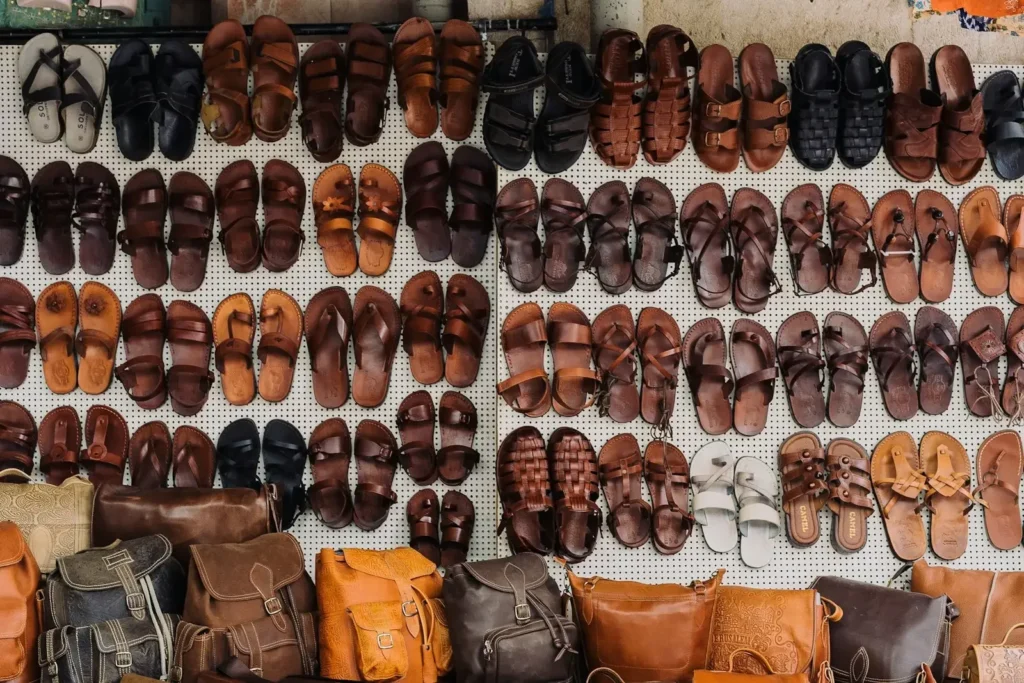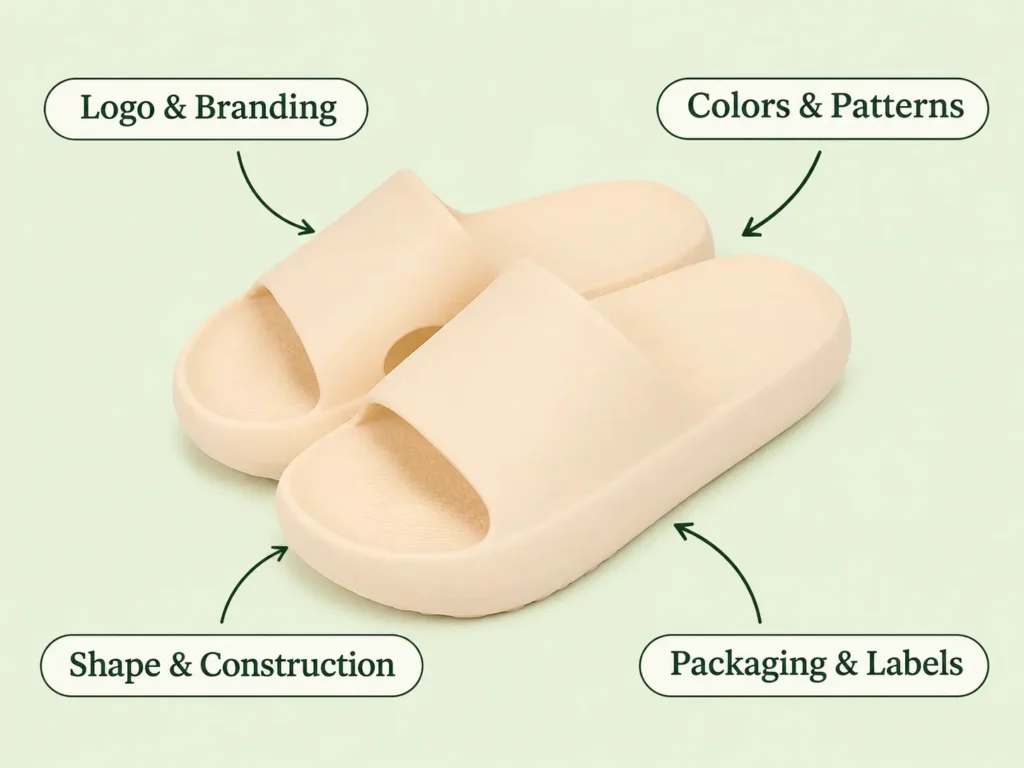
Slippers are made from seven material groups: EVA foam, PVC, PU, rubber and TPR, fabric and plush, wool and felt, and leather with cork. Each group covers a different balance of weight, cushioning, water resistance, durability, and cost, and most finished slippers combine at least three of them: one material for the upper, one for the cushioning layer, and one for the outsole.
| Layer | Common materials | What it decides |
| Upper | Plush, knit, felt, suede, PU leather, moulded EVA | Appearance, warmth, protection |
| Lining | Plush, fleece, jersey, brushed knit | Skin feel, moisture, internal volume |
| Cushioning | PU foam, memory foam, EVA | Initial softness, pressure relief |
| Footbed | EVA, cork-latex, foam with textile cover | Arch shape, shape retention |
| Outsole | EVA, TPR, rubber, dotted fabric | Grip, abrasion, weight, noise |
The seven are easier to judge once the component stack they sit inside is clear.
What Are Slippers Made Of?
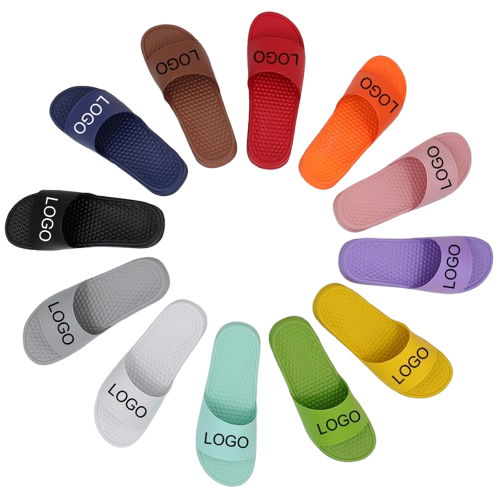
A slipper is a stack of layers rather than a single material. An upper covers the foot, a lining touches the skin, a cushioning layer absorbs impact, a footbed shapes the surface under the arch, and an outsole meets the floor, with thread, adhesive, binding tape, and labels holding the assembly together. Material choice happens layer by layer, which is why the question rarely has a one-word answer.
The Upper and Lining Must Be Approved Together
A thick lining adds warmth and comfort, but it also consumes internal volume, which changes the opening and how the size feels on the foot. A slipper that measures correctly and still feels tight usually has a lining problem rather than a sizing problem, so the two layers should be signed off as a pair rather than as separate line items.
Density Is Not the Same as Hardness
These two figures get used interchangeably in marketing and mean entirely different things. Density is mass per unit volume, describing how much material is packed into the foam. Hardness is resistance to indentation, measured with a durometer under a standard method such as ASTM D2240. A foam can be dense and soft, or light and firm, and neither number predicts how the product feels after three months of wear.
That distinction matters at the quoting stage. High density, extra thick cushioning, and memory foam footbed are not specifications; thickness at a named measuring point, durometer reading on the finished part, and pair weight are. Buyers who accept the marketing term instead of the number generally find the gap in the first bulk shipment.
The 7 Common Slipper Materials
EVA carries volume, PVC carries cost, PU carries premium positioning, rubber and TPR carry durability, fabric and plush carry warmth, wool and felt carry temperature regulation, and leather with cork carries support and perceived value. None of them is a general-purpose winner; each is the right answer inside a specific price band and use case.
EVA Foam
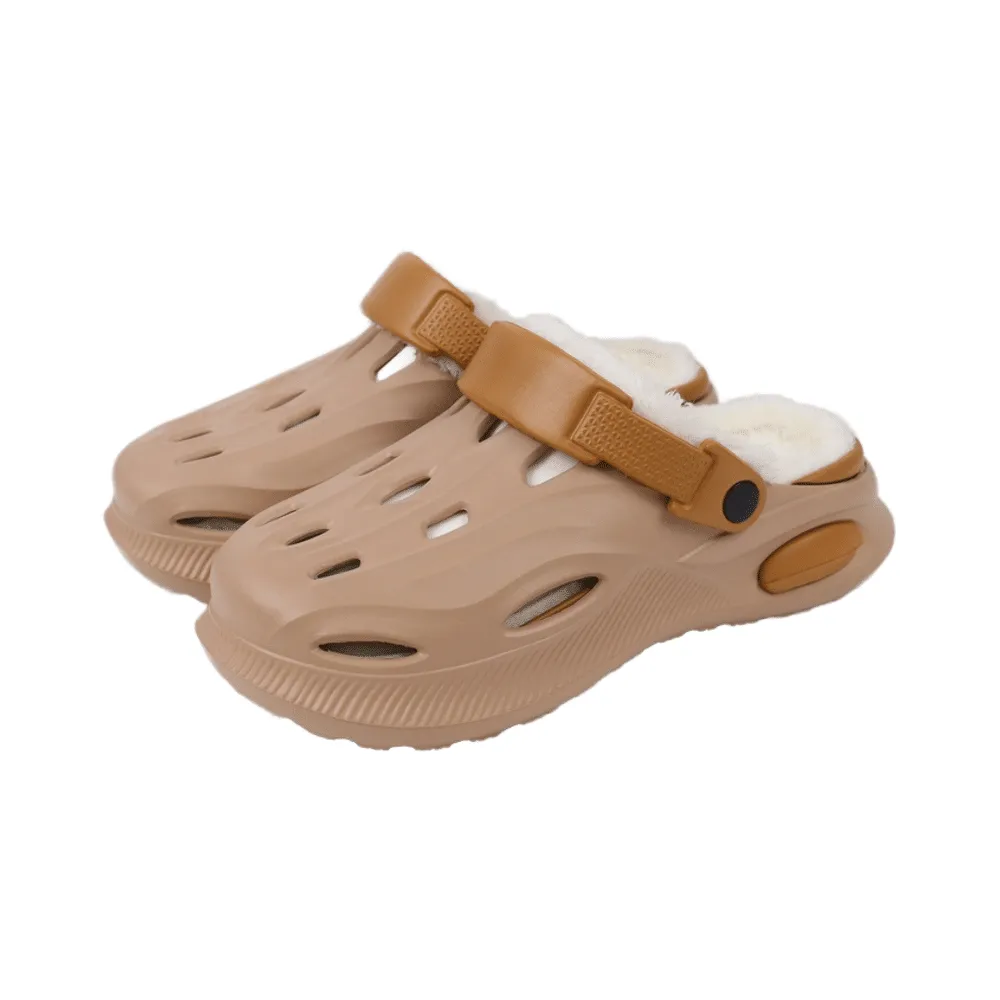
EVA is a closed-cell foam, so water does not pass through the sole body, and it moulds into a complete slipper in one operation. Production splits three ways, die-cut from sheet, compression moulded, and injection moulded, and the three give different surface finish, dimensional accuracy, and tooling cost. Supercritical foaming produces a finer cell structure with better rebound at a higher price. The limits are heat softening and compression set under sustained load, which is why custom EVA slippers perform best when the sole is thick enough to resist flattening at the heel.
PVC
PVC is heavier, harder, and cheaper than EVA, and it injects quickly, which is why it dominates bathroom and high-turnover hotel programmes. It handles standing water well and wipes clean, but it feels cold underfoot, offers little cushioning, and is difficult to recycle. One compliance point is easy to miss: PVC needs plasticisers, and several phthalates used for that purpose are restricted in major markets, so the formulation matters as much as the material name.
PU (Polyurethane)
PU is the most misused term in the category, because it describes two unrelated products. PU foam is a cushioning material, poured or moulded into footbeds and midlayers, valued for light weight and pressure distribution. PU synthetic leather is an upper material, coated onto a fabric backing, valued for a consistent surface and leather-like finish. Both sit at the premium end, and both share the same weakness: hydrolysis. In hot, humid storage PU can degrade and crumble, so shelf life and shipping conditions belong in the specification.
Rubber and TPR
Rubber delivers the best abrasion resistance and wet grip, which is why outdoor slippers survive pavement and poolside tile. TPR is a different material: a thermoplastic rubber that injects like plastic, giving crisp moulded sidewalls and tread at a lower tooling cost than vulcanised rubber, though it stiffens in cold conditions. Many cost-effective designs split the job, using an EVA midsole for cushioning and a rubber outsole for grip, which is why flip flops manufacturer programmes often run both materials in one plant.
Fabric, Plush, and Knit
Textile solves what foam cannot: moisture. Plush and fleece trap warm air and feel soft against skin, jersey and interlock knit take print well and stay light, and both suit bedroom and gift products. For bulk orders of fuzzy slippers, the specification work sits in details buyers often skip: pile height, fabric weight per square metre, backing stability, shedding, and how clearly a logo reproduces on a textured surface. Thick pile also reduces internal volume, so it changes fit.
Wool and Felt
Wool regulates temperature in both directions, absorbing moisture vapour when the foot is warm and releasing it when cold, which is why it outperforms synthetic plush in heated rooms. Felt, made by matting and pressing fibres, holds a moulded shape without binding or edge finishing, so it suits structured slip-on styles. One caution: wool felt should only be claimed when fibre content is documented, since much commercial felt is blended or entirely synthetic.
Leather, Suede, and Cork
Leather and suede raise perceived value and hold shape, and they age visibly, which some markets reward. The costs are price, care requirements, and colour migration from dark linings onto pale floors or socks. Cork works differently: granulated cork bound with latex is moulded into a footbed that is firm rather than soft and gradually conforms to the arch, which is why support-focused slippers use it instead of foam.
Slipper Materials Compared
There is no all-round best material, only a best weighting. If the brief prioritises cost and water resistance, PVC wins; if it prioritises weight and moulding freedom, EVA wins; if it prioritises grip and abrasion, rubber wins; if it prioritises warmth, wool and plush win; if it prioritises support and shelf appeal, cork and leather win.
| Material | Comfort | Abrasion | Weight | Water resistance | Breathability | Cost | Recyclability |
| EVA | High | Medium | Very light | High | Low | Low | Moderate |
| PVC | Low to medium | Medium | Medium | High | Very low | Lowest | Poor |
| PU foam | High | Low | Light | Low | Low | High | Poor |
| PU leather | Medium | Medium | Light | Medium | Low | High | Poor |
| Rubber | Medium | Very high | Heavy | High | Very low | Medium | Moderate |
| TPR | Medium | High | Medium | High | Very low | Low | Moderate |
| Plush and knit | High | Low | Light | Low | Medium | Low | Moderate |
| Wool and felt | High | Low to medium | Light | Low | High | Medium | Good |
| Cork-latex | High | Medium | Medium | Low | Medium | High | Good |
How to Choose the Right Slipper Material
A good material is not the one with the strongest properties, it is the one aligned with three things: the retail price the product must hit, the channel it sells through, and the environment it will actually be used in. Fix those three first and the material shortlist generally falls out on its own.
Start With Retail Price and Channel
A hotel programme buying thousands of pairs a season needs low unit cost and predictable sizing, which pushes toward PVC or basic EVA. A lifestyle brand selling through its own store can absorb PU or wool, because the material story is part of what the customer is paying for. Setting the price band first prevents the common failure of designing a premium material into a product that has to retail at an entry price.
Match the Material to the Environment
Wet tiled surfaces need drainage and wet grip, so rubber or textured TPR. Cold bedrooms need wool or high-pile plush. Hot climates punish thick foam with heat deformation and punish PU with hydrolysis. Storage matters too, because a warehouse without climate control in a humid region will expose every weakness in a single summer.
Three Specs Buyers Forget to Write Down
- Thickness measured at a named point, on the finished part rather than the raw sheet.
- Pair weight tolerance, since a visibly mismatched pair reads as a quality defect even when dimensions match.
- Colour migration, tested with dark lining against pale sole and pale sock.
These account for a large share of claims that never show up in a lab report, and each takes minutes to specify. Buyers who write them down find that quotations for wholesale house slippers become genuinely comparable rather than roughly indicative.
Which Slipper Types Suit Which Materials?
Slippers come in ten main types, and each has a conventional material pairing that has survived because it solves that style’s specific failure mode. Matching a valid material to the wrong style is a more common sourcing error than choosing a poor material outright.
| Type | Usual material pairing | Failure mode if mismatched |
| Flip-flop | Rubber or EVA sole, rubber strap | Post pulls out of a soft sole |
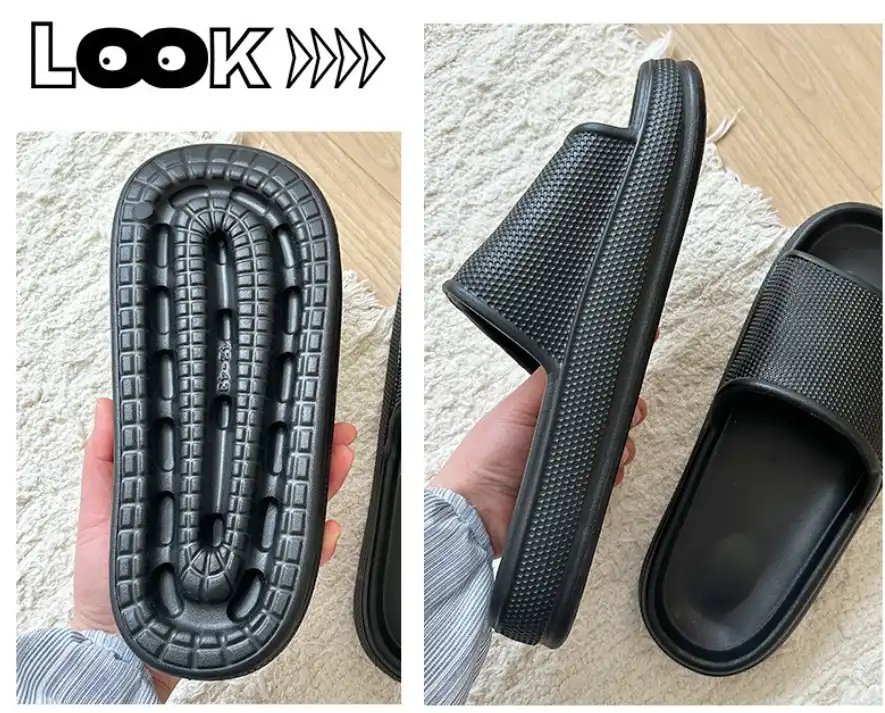
| Slide | Moulded EVA, single band | Foot rolls over a low sidewall |
| Clog | Moulded EVA or PVC, optional strap | Toe box deforms under heat |
| Mule | Suede or PU leather upper, EVA or TPR sole | Upper separates at the lasting edge |
| Scuff | Wool felt or plush, soft sole | Sole wears through at the ball |
| Classic slip-on | Knit or jersey upper, EVA sole | Collar stretches out of shape |
| Ballerina | Fabric or satin upper, thin EVA sole | Sole delaminates in laundering |
| Moccasin | Suede or leather, stitched sole | Stitch line abrades on hard floors |
| Bootie | Fleece or knit, rubber or TPR sole | Lining packs down and loses warmth |
| Therapeutic | Cork-latex or firm EVA footbed | Support feature lands off the arch |
Materials and Manufacturing: Where the Cost Comes From
Material choice determines the process, and the process determines tooling cost, minimum order quantity, and lead time. Foam is moulded or cut, PVC and TPR are injected, rubber is vulcanised, and PU is cast, so each route carries a different fixed cost before the first sellable pair exists.
| Material | Typical process | Tooling implication |
| EVA | Compression, injection, or die-cut sheet | Mould per size run, or cutting dies only |
| PVC | Injection moulding | Steel or aluminium mould, higher fixed cost |
| TPR | Injection moulding | Similar to PVC, compound-dependent |
| Rubber | Vulcanisation | Mould plus cure cycle, longer lead time |
| PU | Casting or pouring | Mould plus chemistry control |
| Cork-latex | Compression moulding | Mould plus binder ratio control |
Two things follow. A material swap that looks cosmetic on a sample can change the mould, the cycle time, and therefore the quoted price, so substitutions need a process review rather than a colour match. And inspection is not compliance: a visual and dimensional check proves nothing about restricted substances, and for the EU market the obligations sit in REACH, which places the burden on the supplier to document substance content rather than to assert safety. Buyers moving from sample to bulk will find the whole sequence laid out in this guide to how are slippers made.
FAQ
These three questions arrive after a material has already been chosen, at the point where the buyer needs to know whether it will hold up rather than how it compares.
Is memory foam a material or a construction?
It is a construction detail more often than a material claim. Memory foam is a viscoelastic polyurethane that softens with body heat and returns slowly, and in slippers it usually appears as a thin layer inside a footbed rather than as the entire sole. What decides the experience is the layer beneath it, because without a firmer support layer a memory foam top compresses fully and the wearer feels the floor.
Why do some new slippers smell when the box is opened?
The usual causes are residual blowing agents in freshly moulded foam, plasticiser in PVC, and adhesive solvent in glued assemblies. Most of it dissipates within days of unpacking, but a sharp solvent smell that persists points to adhesive that has not fully cured, which is a process problem rather than an unavoidable property of the material. An odour check at final inspection catches it before shipment.
Can recycled material be used without changing the product?
Partly. Recycled EVA and recycled rubber are well established in midsoles and outsoles, usually blended with virgin material to protect consistency, and the practical limit is colour: recycled content rarely delivers a clean white or a precise pastel. Recycled textile is harder still, because fibre length and shade consistency both drop. The workable approach is to place recycled content where colour tolerance is loose and keep the visible upper on virgin material.