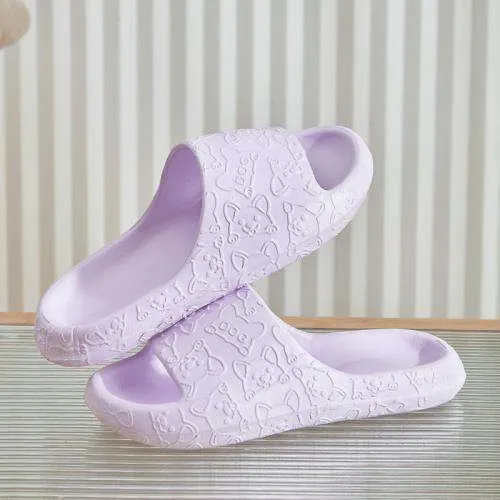
Introduction: Why Material Decisions Matter More Than Green Labels
Bio-based EVA slippers are attracting attention from footwear brands, hospitality buyers, wholesalers, and retailers that want to reduce dependence on fossil-based feedstocks without giving up the lightweight comfort associated with EVA footwear. The opportunity is real, but the terminology is often confusing. A slipper can contain bio-based content without being biodegradable. It can be reusable without being recyclable in a buyer’s local waste system. It can also carry an environmental claim that is technically correct but too vague to support a responsible product story.
For B2B buyers, the right question is not simply, “Is this slipper green?” A better question is: What is the material made from, how does it perform, how long can the product remain in use, and what recovery route is realistically available at the end of its service life?
This guide explains the material logic behind bio-based EVA slippers, the meaning of recovery, the performance and compliance checks buyers should request, and the design choices that can make a slipper easier to reuse or manage after use.
What Is Bio-Based EVA?
EVA stands for ethylene-vinyl acetate, a polymer widely used in footwear because it can be formulated to provide low weight, cushioning, flexibility, water resistance, and a comfortable underfoot feel. Conventional EVA is generally produced from fossil-based chemical feedstocks. Bio-based EVA uses renewable feedstock for some or all of the relevant building blocks, depending on the resin grade and the supplier’s formulation.
A commonly discussed route is the use of sugarcane-derived ethanol to produce renewable ethylene. Braskem, for example, describes its bio-based EVA as being made from renewable sugarcane-based feedstock and has documented applications in footwear, including reusable hotel slippers. This does not mean every product marketed as “bio-based EVA” has the same renewable content. Buyers must ask for the exact grade, the percentage of bio-based content, and the certification or chain-of-custody documentation supporting the claim.

The term “bio-based” describes the origin of the feedstock. It does not automatically describe:
- Whether the finished product is biodegradable
- Whether it is compostable
- Whether it contains recycled content
- Whether it can be collected and recycled locally
- Whether the entire product has a lower impact in every environmental category
Those are separate questions that require separate evidence.
Bio-Based Does Not Mean Biodegradable
This distinction is essential for accurate product communication. A bio-based polymer can have renewable carbon content while still behaving like a durable synthetic polymer during use and disposal. In practical terms, the material may last longer precisely because it is designed to resist water, deformation, and everyday wear. That is why durability, not biodegradability, is the more realistic claim for most bio-based EVA slippers.
That durability is not a weakness. For a slipper, a longer useful life can reduce replacement frequency and help prevent premature disposal. However, brands should not describe bio-based EVA slippers as biodegradable or compostable unless the exact finished product has been tested against an appropriate standard and the claim is valid for the intended disposal environment.
A responsible product page should therefore use precise wording such as:
- “Made with bio-based EVA content,” when the renewable material content has been documented
- “Designed for repeated use,” when the construction and care instructions support reuse
- “Potentially recoverable through an identified program,” only when a real collection route exists
Avoid broad claims such as “zero impact,” “fully sustainable,” or “completely eco-friendly.” These statements are difficult to prove and can create regulatory and reputational risk in international markets.
What Does “Recovery” Mean in Recovery Slippers?
“Recovery slippers” is not a universal material classification. In a B2B product program, it should be treated as a design and end-of-life strategy rather than as a single resin type. Recovery can include several different pathways:
- Reuse: The same pair is washed, inspected, and used again.
- Repair or component replacement: A strap or another simple component is replaced instead of discarding the whole product.
- Material recovery: Suitable EVA is collected and processed into a secondary material where the required infrastructure exists.
- Repurposing: Used products are redirected to a different application with lower performance requirements.
- Energy recovery or controlled disposal: The final route depends on local regulations and waste infrastructure.
UNEP describes circularity through value-retention loops such as reduce, reuse, repair, refurbish, repurpose, and recycle. For slippers, the most realistic first objective is often to reduce unnecessary replacement and extend the useful life. Recycling is important, but it should not be promised without a defined collection, sorting, and processing system.
Why Bio-Based EVA Is Attractive for Slipper Manufacturing
Several material and design properties make bio-based EVA slippers attractive for manufacturers and buyers alike.
Lightweight Comfort
EVA can provide a low-density structure that helps keep a pair light and easy to pack. This is valuable for travel, hotel amenities, promotional programs, and online retail, where shipping weight and parcel volume influence operating costs.
Cushioning and Flexibility
By adjusting the formulation, foaming process, density, and hardness, manufacturers can produce different comfort profiles. A soft formulation may feel comfortable for indoor use, while a firmer compound may offer more support and shape retention for everyday outdoor wear.

Water Resistance and Easy Cleaning
EVA footwear is commonly selected for bathrooms, resorts, spas, pools, and casual summer use because the material is easy to wipe and resistant to short-term water exposure. Still, “water-resistant” is not the same as “immune to all conditions.” Long exposure to heat, ultraviolet light, oils, or harsh chemicals can affect color, surface finish, and mechanical properties.
Design Flexibility
EVA can support molded shapes, textured footbeds, patterned outsoles, different strap constructions, and a wide range of colors. For private-label programs, brands can combine a bio-based material option with logo embossing, laser treatment, printing, custom colors, or packaging while keeping the core product architecture efficient.
Compatibility With Reuse Programs
A durable, washable design can be suitable for controlled reuse programs. The most successful programs define how products are collected, cleaned, inspected, and removed from circulation. A reusable claim should therefore be connected to an operating procedure, not only to the material name. In practice, bio-based EVA slippers only earn a reuse claim when every step of that procedure is defined.
Material Performance: What Buyers Should Test
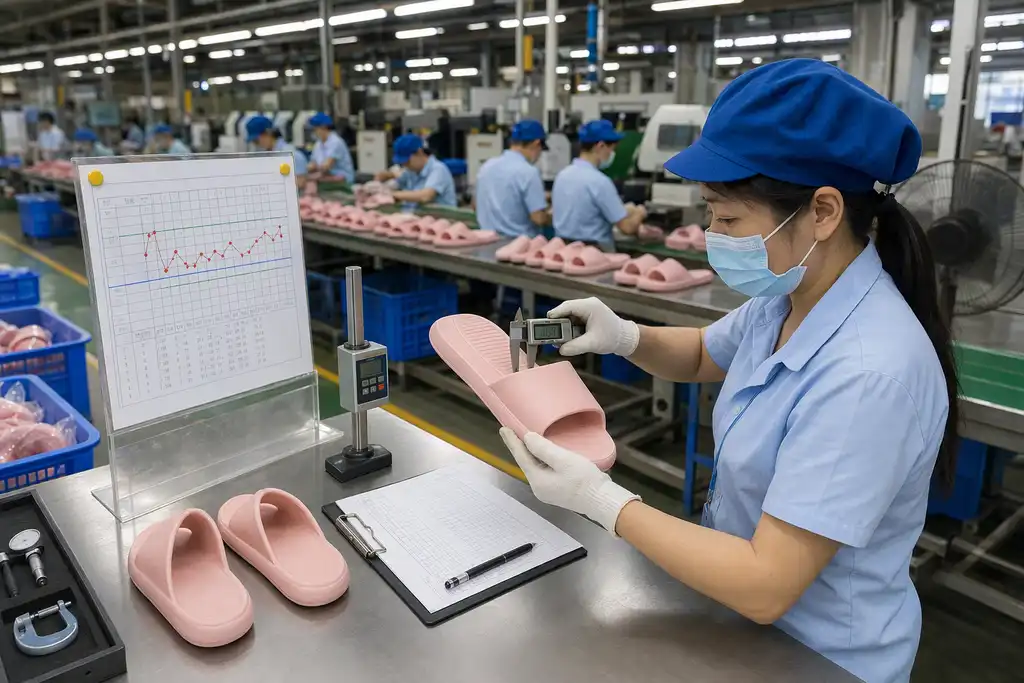
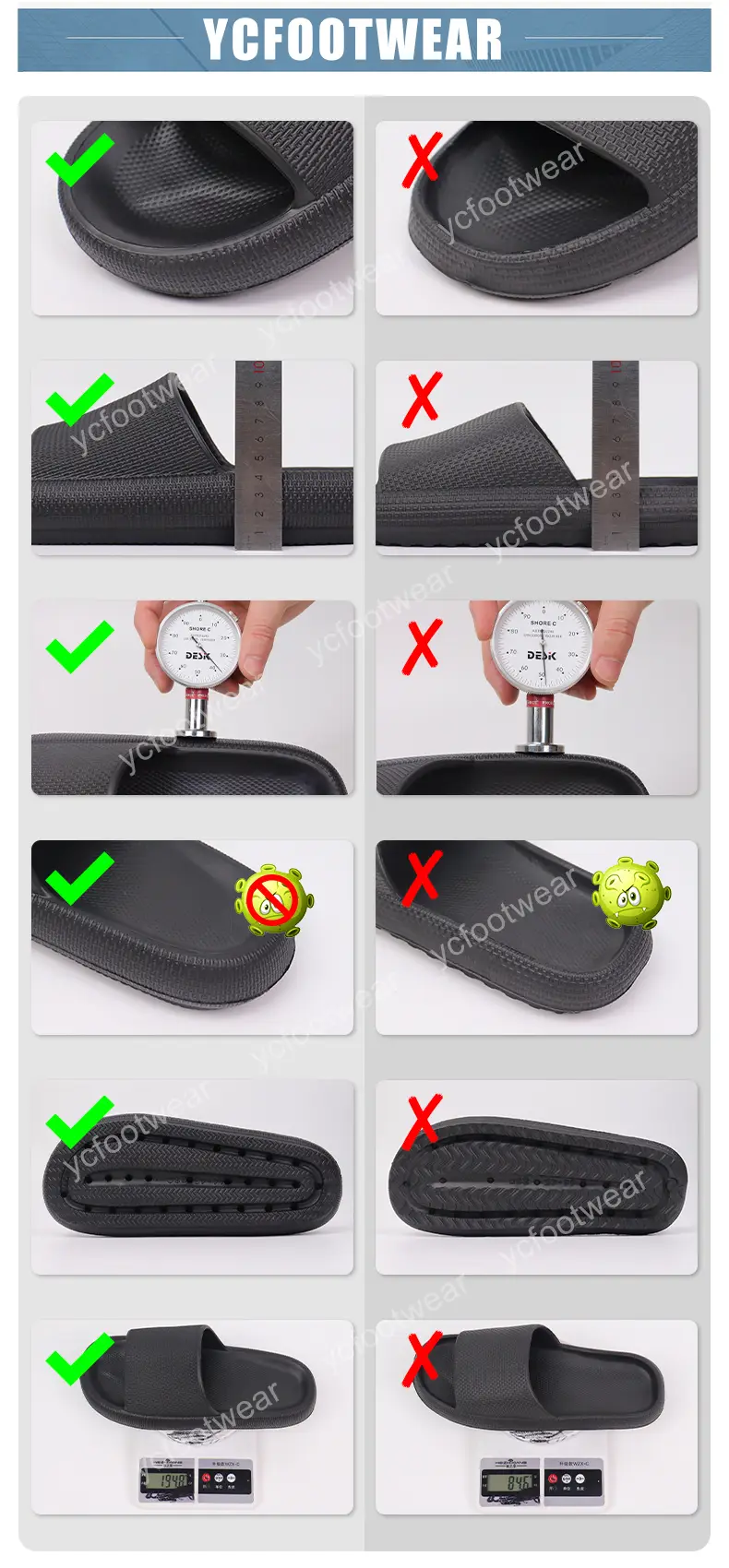
Sustainability does not replace performance testing. A material that fails early may create more waste, returns, and replacement demand. Before approving a pair of bio-based EVA slippers, buyers should review a sample and request a clear test plan covering the actual use environment, and confirm how slipper quality control is handled before shipment.
Hardness and Comfort
Hardness affects underfoot feel, compression response, and perceived support. Buyers should compare samples under the same test conditions rather than relying only on a single Shore hardness number. A comfortable hotel slipper and a durable outdoor slide may require different targets.
Compression Set and Shape Retention
Compression set indicates how well the foam recovers after being compressed. Poor recovery can lead to a flat footbed, reduced cushioning, and an inconsistent fit. For repeated-use programs, this test is especially relevant because the product may be worn, stacked, washed, and stored many times.
Flex Fatigue and Strap Strength
The sole should withstand repeated bending without cracking or permanent deformation. Straps need separate attention because they can be the first component to fail. Buyers should test strap pull strength, attachment quality, and repeated flexing rather than evaluating only the visual appearance of a new sample.
Slip Resistance
Outsole performance depends on tread design, compound, surface contamination, and the floor environment. A slipper intended for a spa, hotel bathroom, or poolside area should be assessed under the conditions it is likely to encounter. Do not transfer a slip-resistance claim from one surface or test method to every market without checking the applicable requirement. This matters most for bio-based EVA slippers used in spa, hotel, and poolside settings.
Color and Surface Stability
Bio-based content does not automatically determine colorfastness or UV stability. Request testing or documented specifications for the intended colors, especially for pale tones, dark pigments, and products exposed to sunlight. Surface texture and printing methods should also be checked after washing and repeated handling.
Designing Bio-Based EVA Slippers for Reuse and Recovery
For bio-based EVA slippers, material selection is only one part of circular product design. The overall construction can make recovery easier or harder; the same design choices that cause slippers to fall apart early also make reuse impossible.
Reduce Unnecessary Material Complexity
A simple, mono-material or near-mono-material construction may be easier to sort than a product combining several permanently bonded materials. Buyers should review the sole, strap, adhesive, printed layer, label, and packaging as one system.
Make Cleaning Practical
If a product is intended for repeated use, cleaning instructions must be realistic. The design should tolerate the proposed cleaning method without excessive color loss, deformation, odor retention, or strap damage. A reuse program should define inspection criteria and a clear point at which the product is removed from service.
Consider Mechanical Connections
Where appropriate, detachable or replaceable components may extend product life. However, a more complex connection is not automatically better. It must remain secure during use, be practical for workers to service, and avoid creating a new safety risk.
Separate Product and Packaging Decisions
A bio-based slipper can still be surrounded by unnecessary packaging. Buyers should ask whether packaging can be reduced, reused, or made from a documented recycled or renewable input. Packaging claims should be verified independently from footwear material claims.
Documentation and Compliance Questions for Suppliers
A serious B2B material review for bio-based EVA slippers should include documentation, not just a sustainability presentation. Ask the supplier or manufacturer for:
- The exact EVA resin grade and supplier name
- The percentage of bio-based content and how it is calculated
- A certification, mass-balance statement, or chain-of-custody document where applicable
- Technical data for density, hardness, compression, and aging
- Testing records for straps, outsole performance, and color stability
- A restricted-substances declaration for the intended market
- REACH-related information when the product is supplied to the European market
- Confirmation of any PFAS-related requirements requested by the buyer or destination market
- A written description of the proposed reuse or recovery route
ECHA explains that REACH can create information and communication obligations for articles, including obligations related to substances of very high concern. The exact requirement depends on the material, article, market, and supply-chain facts. A general statement such as “eco-friendly material” is not a substitute for market-specific compliance documentation.
Buyers should also keep marketing language aligned with evidence. If a supplier provides a renewable-feedstock certificate but no evidence for recycling access, the product may be described as containing bio-based material, but not as universally recyclable. For programs built around low MOQ custom EVA slippers, the same documentation standard applies from the first sample order.
How to Compare Bio-Based EVA With Conventional EVA
To compare bio-based EVA slippers with conventional EVA fairly, use a like-for-like basis. Compare the same product shape, density, hardness, color, strap design, packaging, production yield, expected service life, and logistics route. Otherwise, the result may reflect design differences rather than the effect of feedstock.
A practical comparison table for internal sourcing decisions can include:
| Category | Questions to ask |
|---|---|
| Feedstock | What portion of the polymer comes from renewable feedstock? |
| Performance | Does the bio-based grade meet the same hardness, flex, and durability targets? |
| Manufacturing | Does it require changes to molding, foaming, trimming, or color matching? |
| Product life | Can the slipper remain in use for the same or longer period? |
| Reuse | Can the design be washed, inspected, and redistributed safely? |
| Recovery | Is there a real collection and processing route in the target market? |
| Compliance | What documents support the destination-market requirements? |
| Communication | Can the claim be explained clearly without implying biodegradability? |
The best material choice is not always the one with the most impressive label. It is the one that meets the buyer’s performance, compliance, cost, and end-of-life requirements with evidence.
Questions to Ask Before Placing a Custom Order
Before approving a low-MOQ or private-label program for bio-based EVA slippers, buyers should clarify:
- Is the bio-based EVA available for the requested color and hardness?
- Is the material available for both trial orders and repeat production?
- Will the same resin grade be used for future batches?
- Can the supplier provide a retained sample or reference standard?
- What is the minimum order quantity for a custom material or color?
- Are mold, color matching, printing, and packaging costs quoted separately?
- What testing is included before mass production?
- How will defects, color variation, or strap failures be handled?
- If the product is reusable, what cleaning and inspection instructions will be supplied?
- What end-of-life claim can be supported in the buyer’s target market?
These questions help prevent a common sourcing mistake: approving the sustainability story before confirming the production details.
Conclusion: Build a Better Material Story With Better Evidence
Bio-based EVA recovery slippers can give footwear brands a practical route toward renewable feedstock, lightweight comfort, and more deliberate circular design. The strongest programs do not rely on a single green label. They connect four elements: verified material origin, reliable product performance, a realistic reuse or recovery plan, and accurate market communication.
For buyers, the priority should be to define the intended use first. A washable hotel slipper, a promotional giveaway, and a daily outdoor slide have different service-life and recovery requirements. Once the use case is clear, the buyer can select the appropriate EVA grade, test the finished construction, simplify the product system, and document the environmental claim.
The most credible bio-based EVA slippers are not the ones with the loudest promise. They are the ones that perform well, last as intended, can be managed responsibly after use, and give every link in the supply chain enough evidence to communicate honestly.