Private label slippers are one of the most accessible entry points into footwear e-commerce, but the moment your order leaves the factory, it is the labels and barcodes that decide whether it sells. A pair can be perfectly molded, comfortably cushioned and beautifully colored, yet still be rejected at a customs checkpoint, refused at a retailer’s receiving dock or delisted on a marketplace because of a missing origin mark, an unreadable barcode or a label that does not match the destination market’s rules.
In a private label slipper program, the brand owner supplies the trademark, the label artwork and the barcode numbers, while the factory prints and applies them to your specification. Labels must satisfy the legal requirements of the destination market, such as country of origin and material composition, and barcodes must be valid GS1-issued numbers assigned to every size and color variant you sell.
The sections below break down exactly what goes on a slipper label, how barcode ownership and numbering work, and how to manage the entire process with your manufacturer.
What Private Label Slipper Labeling Actually Covers
Private label slipper labeling covers three distinct layers: the legal markings required by the destination market, the brand identity elements that make the product yours, and the machine-readable identifiers that let retailers and marketplaces track it.
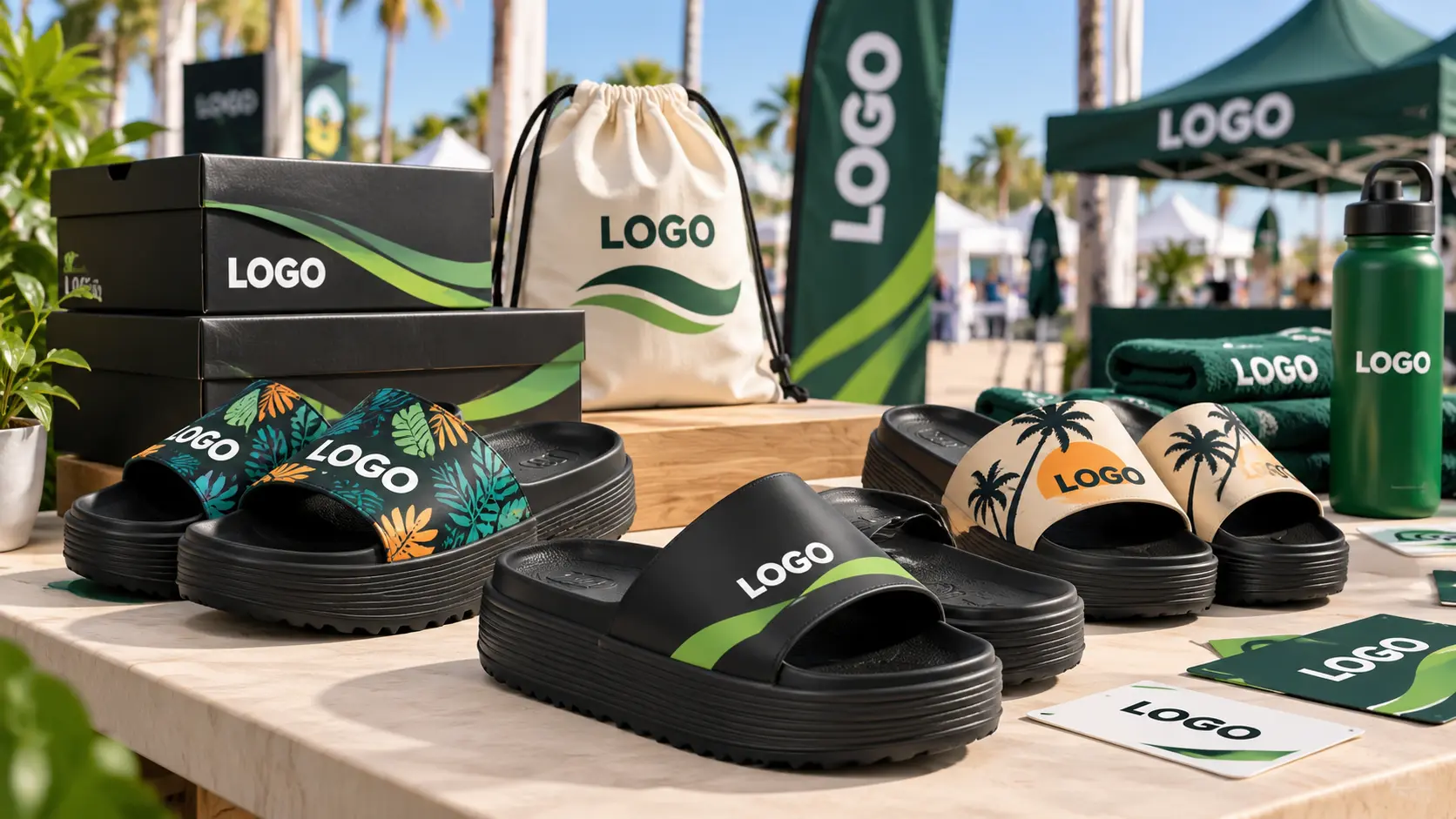
Buyers often treat “labeling” as a single sticker, but in a production setting it is a package of coordinated elements. Each one has its own artwork, placement and approval process, and each one can stop a shipment if it is wrong.
| Label Element | Typical Carrier | What It Does |
| Brand name and logo | Woven or printed label, hangtag, insole print | Establishes your brand identity |
| Size marking | Label, insole print, box end label | States size in the destination system |
| Material composition | Label or pictogram tag | Discloses upper, lining and outsole materials |
| Country of origin | Label or direct print | Legally required marking for imports |
| Care instructions | Hangtag or label | Optional for slippers but expected by some retailers |
| Barcode | Shoe box, polybag, carton | Enables scanning at retail and in warehouses |
Confirming all six elements in writing before bulk production begins is what separates a smooth private label launch from a shipment that stalls in compliance review. Build the specification early, because label artwork and packaging materials carry their own lead times and minimum order quantities, and discovering a missing element in the final week of production leaves no time to correct it.
How Does a Private Label Work for Slippers?
Private labeling works by splitting responsibility: you own the brand, the product specification and the compliance data, and the factory manufactures the slippers and applies your branding and labeling exactly as specified. You never manufacture the product, but the product legally and commercially belongs to your business.
This model is popular because it lets a new footwear brand launch without a factory, tooling or production staff. If you are weighing private label slippers against other sourcing models, understanding this division of labor is the first step.
The Brand’s Side and the Factory’s Side
The brand owner is responsible for:
- Registering or owning the trademark used on the product
- Providing approved label artwork, including size, composition and origin content
- Licensing barcode numbers and supplying the full barcode list
- Confirming the labeling rules of every market the slippers will be sold in
- Supplying any retailer or marketplace packaging manual
The factory is responsible for:
- Producing the slippers to the agreed specification
- Printing labels and barcodes to the approved artwork
- Applying each label to the correct position on the product, box and carton
- Verifying label placement and barcode scanability before shipment
Every one of these items should exist as a written specification, not a verbal agreement. Ambiguity on either side is what produces mismatched labels at the packing stage.
What Information Must Appear on a Slipper Label?
There is no universal slipper label. The required information depends on the destination market, but the core items are country of origin, material composition, size and the identity of the brand or importer. Confirm the exact requirements before artwork is approved, not after production.
The two largest markets illustrate how different the rules can be.
Size marking deserves separate attention when slippers are sold internationally. A single pair may need to show US, UK or EU sizes, and the size printed on the insole, the label and the box end must agree across all three. A mismatch between the marked size and the actual fit is one of the most common causes of marketplace returns, so confirm the size system for each destination market at the artwork stage rather than after the first customer complaint.
United States Market Requirements
For slippers entering the United States, country of origin marking is mandatory: imported footwear must be legibly and permanently marked in English so the final purchaser can identify where it was made. The Federal Trade Commission’s labeling requirements guidance explains how fiber content and origin rules apply to footwear and textile accessories, and the FTC’s leather guides govern whether materials can be described as leather or must be labeled as imitation leather, vinyl or plastic. Care instructions are generally not required for slippers, but material claims and origin markings are enforced.
European Union Market Requirements
The EU takes a different approach. Footwear sold in the European Union must carry information on the composition of the upper, the lining and insole, and the outer sole, using either standardized pictograms or text, as set out in Directive 94/11/EC. Where no single material accounts for at least 80 percent of a component’s surface area, the two main materials must both be shown. Origin marking is not harmonized at EU level for footwear, but individual national rules and retailer policies frequently ask for it.
Barcodes and GTINs: Who Provides Them and How They Work
Barcode numbers belong to the brand, not the factory. They are issued against a company prefix that you license from GS1 in your country, and a manufacturer cannot generate valid numbers on your behalf. What the factory does is print and apply your numbers correctly.
This is the single most common misunderstanding in private label slipper production. A supplier that “creates” barcodes without your prefix is producing numbers that no retailer or marketplace system will recognize as yours, which can invalidate an entire shipment.
Each sellable variant needs its own Global Trade Item Number, as defined in the GS1 GTIN standard. One slipper style offered in 3 colors and 5 sizes requires 15 separate numbers, not one. When your slippers manufacturer prepares the packing list, that number list must map cleanly to the size and color matrix; if the two lists disagree, packing stops.
Choosing the Right Barcode Symbology
| Symbology | Typical Use | Where It Appears |
| UPC-A | North American retail | Shoe box, hangtag |
| EAN-13 | Retail outside North America | Shoe box, hangtag |
| ITF-14 | Carton-level identification | Outer carton |
| GS1-128 | Logistics and shipment data | Carton label, pallet |
Retail-level codes and carton-level codes are different labels with different sizes and quiet zones. Specify which symbology goes on which packaging layer in your specification sheet.
Placement and Print Quality
A barcode that looks perfect on screen can fail on cardboard. Scanning depends on print contrast, quiet zones and surface flatness, so always request a physical proof and scan test before bulk printing. Dark bars on a light background, full-height bars and placement away from box edges and curves are the practical requirements that decide whether a scanner reads the code on the first pass.
Retailer and Marketplace Rules
Beyond legal and GS1 requirements, each sales channel layers on its own rules. Large chains publish vendor packaging manuals that specify carton label placement, scanning locations and maximum carton weights, and they issue chargebacks when a shipment deviates. Online marketplaces verify that the GTIN on your listing matches the GS1 database record for your brand before the product can go live. These channel rules change independently of labeling law, so collect the current version of every retailer manual and marketplace policy before finalizing packaging artwork rather than relying on a previous season’s spec.
What Are the Downsides of Private Label Brands?
Private labeling is legal and widely used, but the brand owner carries all compliance, quality and inventory risk. The factory executes your specification; if the specification is wrong, the consequences land on your business, not the factory.
Is Private Labeling Legal?
Yes. Private labeling is a standard commercial arrangement used across retail, and placing your own brand on manufactured goods is entirely lawful. The legal obligations attach to the label content itself: the trademark must not infringe an existing mark, the country of origin must be truthful, and material claims must be accurate. A brand that copies a protected design or prints an inaccurate origin statement faces infringement claims or customs penalties regardless of who physically applied the label.
Compliance and Inventory Risks
The practical downsides concentrate in three areas:
- Compliance exposure. Wrong origin wording or missing composition labeling can hold goods at customs, trigger relabeling fees or draw marketplace takedowns.
- Chargebacks. Retailers issue fees for unreadable barcodes, misplaced carton labels or data mismatches between the shipment and its electronic records.
- Inventory commitment. Private label runs are usually tied to minimum order quantities, and unsold branded stock cannot be resold to another buyer. Where your program involves dedicated molds, ownership terms matter as well; the question of who controls tooling is covered in any serious private mold slipper customization agreement.
How to Manage Labeling and Barcodes with Your Slipper Manufacturer
Manage labeling with a controlled sequence: a written label specification, physical proofs approved before bulk, and a pre-shipment scan verification. Treating labeling as a QC step rather than a printing errand is what keeps shipments moving.
A workable process looks like this:
- Confirm the destination market’s labeling requirements with your importer or customs broker.
- Submit label artwork for every label type: brand, size, composition, origin and barcode.
- Send the barcode list as one table mapped to every size and color, with placement stated for each packaging layer.
- Approve a physical proof of every label and a scanned sample of every barcode.
- Require pre-shipment verification: correct label on the correct style, barcodes scanned and matched to the packing list.
The mistakes that cost the most are consistently the same ones: approving artwork from a PDF only, sending a barcode list that does not match the size and color matrix, and assuming origin marking rules are identical in every market. Each is avoided by the sequence above. If you are also comparing suppliers or pricing structures, a practical custom slippers wholesale guide will help you evaluate which manufacturer can actually execute a full labeling program.
Frequently Asked Questions
Do marketplaces require a GS1 barcode for private label slippers?
Most major marketplaces require a valid GTIN for new slipper listings and verify that the number belongs to the seller’s brand through the GS1 database. Codes purchased from resellers or generated by a factory will usually fail this verification, so license your own GS1 company prefix before you list.
Who is liable if a slipper label is wrong, the factory or the brand?
The brand or importer is generally liable to customs authorities, retailers and consumers, because the label represents the brand’s declaration. If the factory misapplied an approved artwork, you may recover costs contractually, but customs penalties, relabeling charges and marketplace actions still land on the brand first. This is why pre-shipment label inspection belongs in every purchase agreement.
How much does labeling and barcoding add to a slipper order?
Labeling itself is usually a small share of unit cost: printed labels, hangtags and barcode application typically add a few cents per pair. The significant costs are setup-related, such as printing plates, artwork preparation and minimum order quantities for custom boxes and tags, which is why consolidating label artwork and ordering packaging with the main production run keeps the overhead manageable.